From: NYU President John Sexton (office.president@nyu.edu)
Subject: A Letter to NYU Graduate Assistants
Dear Graduate Assistants,
Your admission to NYU’s graduate programs represents recognition of your
potential to be part of the next generation of intellectual leaders, as men and
women who will fill the ranks of university faculty throughout the world, as
individuals who will lead lives devoted to advanced inquiry. In providing you
with financial aid and the opportunities and responsibilities of assistantships,
we hope to help prepare you for that life.
We recognize that for some of you there is an unfortunate disparity between
the ideal and the reality. In some instances, assistantships have not been
structured to accomplish what we want: to enhance professional development.
There is always a delicate balance between matching undergraduate curricular
needs with the academic and scholarly interests of those who teach; in the case
of GAs, we have not always achieved that balance. While this is not true in
every department, it is true in some.
Our exchanges with one another have been shaped by this reality and the
mistrust engendered by it. We know we must work to bridge the gulf that has
developed, and to align our realities with our ideals.
The recent announcement within Arts and Science limiting assistantship
responsibilities in languages and literature departments to one stand alone
course per semester is a first step. We know we must take others, but these
academic decisions are best determined by schools and departments. The
University will commit resources in support of these efforts. Moving closer to
this ideal, however, will be difficult without restoring an atmosphere of mutual
respect and good faith within the University community.
We appreciate that for some GAs a collectively bargained contract, driven
by a union, provides a greater sense of security; for them the University’s
August decision to move ahead without the union was wrong. For them and others,
the changes to the student health plan and the errors surrounding Blackboard
created doubts about the University’s good will, when both of these issues could
be understood quite differently in an environment of mutual good faith.
For my part, I will not repeat the challenging history that contributed to
the University’s decision to work directly with our graduate students rather
than through the intermediary of a union. Suffice it to say that we accept that,
as we move forward, the burden is on the University to create an environment of
trust as we aim to achieve the ideal. To this end, we propose the following
pathway: for all current and incoming graduate assistants, the University will
offer written contracts based upon their appointment letters. From our
perspective, these commitments already are binding; nonetheless, we will proceed
to document them in a manner that makes clear to all that these contracts
obligate the University and are legally enforceable. These contracts will detail
the terms described last summer, including:
• $1000/year minimum increases in stipends for the 2005-06 academic year
(already enacted), as well as 2006-07 and 2007-08, plus the publication each
April of the next three year’s stipends;
• continued payment by the University of 100 percent of health care
premiums for the comprehensive student health insurance plan; and
• full tuition remission.
But there is more work to be done, and much of it must be driven by
graduate students themselves. Since the beginning of the fall semester, two
groups of graduate students have set to work on matters of importance to
graduate students generally, and graduate assistants in particular. The Graduate
Student Working Group is crafting a rights-and-responsibilities compact that
will provide a basis for defining the relationship between graduate students and
the University. The Working Group is also formulating a permanent grievance
procedure for graduate students to replace the interim procedures presently in
place. Some members of the NYU community have expressed concern about the
fairness of a grievance procedure that ends with the Provost, a University
official. While we must await the Working Group’s proposals, we are open to any
suggestions they may have regarding how members from the academy outside the
University might play a role in this process.
The Graduate Affairs Committee of the Student Senators Council has also
started to address economic and benefit issues affecting graduate students in
general and GAs in particular. Again, we must see what this group proposes; were
it, however, to offer a new mechanism that would enable graduate assistants
elected at the department level to act as representatives of all GAs in annual
discussions of stipend levels, health care benefits, and other matters of
importance, we would embrace that as part of our university governance
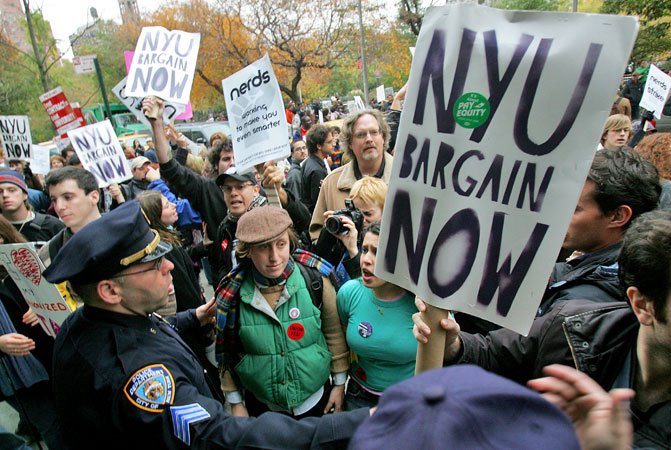
procedures. Lastly, I wish to talk about the strike. Many GAs have continued
teaching, others have taught at off-campus locations, and still others have not
been teaching. I believe that those striking have been acting out of conscience.
Though I fervently disagree with their decision not to teach, I do not think
they made this choice lightly. But however strongly felt a graduate assistant’s
act of conscience may be, it should not be pursued any longer at the expense of
undergraduates.
So far, those who have been on strike have been able to act out of
conscience without experiencing consequences for their actions; instead, the
burdens have fallen on departments, faculty, and, in particular, our
undergraduates. Because graduate assistants are also our students, those on
strike have continued to receive their stipends, they have continued to receive
free tuition, and they have continued to receive free health insurance.
Their points have been made and heard. The time has come for the University
to insist that the academic needs of its undergraduates be met. All of us should
share a deep commitment to meeting these needs. Those undergraduates in classes
affected by the strike are understandably anxious about the disruption to their
studies. Such disruption must not continue. I thank those who have been
teaching, and I ask those who have not to return to the classroom.
For those graduate assistants who resume teaching and other assistantship
assignments by Monday, December 5th (or the first class meeting thereafter) at
the assigned times and places, and who fulfill all assigned responsibilities for
the remainder of the semester, including grading, there will be no consequences.
These GAs will be eligible for teaching and other assignments by the department
for the spring semester. This amnesty represents a balance between our respect
for the principled positions of those choosing to strike and our obligation to
undergraduates, who have a right to complete their semester’s work and
experience no disruption in their courses next semester. Because we take both
responsibilities seriously, graduate assistants who do not resume their duties
by December 5 or the first scheduled teaching assignment thereafter – while
experiencing no consequences for this semester – will for the spring semester
lose their stipend and their eligibility to teach.
For those graduate assistants who return by December 5th and accept a
teaching assignment for the spring, this acceptance comes with the commitment to
meet their responsibilities without interruption throughout the spring semester.
Absences not approved by the dean will result in suspension from assistantship
assignments and loss of stipend for the following two consecutive semesters.
Graduating students will be assessed comparably. None of the striking graduate
students will have their ability to continue their own studies affected. In all
cases, their tuition and health benefits will remain in place, and where the
suspension of stipend would create economic hardship, loans will be provided to
students upon their request.
For those who will be satisfied with nothing less than a union, I know it
will be a disappointment that the University will not recognize GSOC/UAW as the
collective bargaining representatives of NYU’s graduate assistants. I
nonetheless hope that we share a goal to make graduate education at NYU better,
even if we differ about the vehicle for achieving this, and that we can come
together around this goal.
This has been a difficult and rancorous semester. While I do not condone
what has been done by those who have been striking, their actions have caused us
to take a hard and unflinching look at ourselves and our practices, and these
self- examinations will lead to significant, enduring improvements. I hope that
in this spirit we can work together to complete the semester and rebuild the
trust we need.
Sincerely,
John Sexton
So that's it. I want to say one thing: WE ARE WINNING. Sexton is sending this email out because he and the NYU administration are scared. They are scared because the end of the semester is coming and they have no one to grade all the undergrads. They are desperate and they are resorting to desperation tactics, which, however much they may scare the shit out of and infuriate me, are ultimately not going to work because we will not let them work. In the face of these threats, we need to stay strong and we need to recognize how much stregnth we have right now and build from it.
See also: NerdsOnStrike