This is my 2005 year end post. If you're interested, my 2003 year end post is here, and my 2004 year end post is here. A bizarre attempt to narrate both through the viewpoint of a broken cell phone is here.
Before I begin, I would just like to say that I hold the microphone like a grudge. (Best hip-hop video ever, maybe, except what the hell is Flava Flav doing?) I would also like to warn everyone that what follows is to some extent an exercise in Narcissism, and if you just come here to read about GSOC, you're more than welcome to skip it.
2005 was like 2004 in the sense that it was an extended experiment in liminality. I walked all over New York City. I spent a lot of time alone. I spent a lot of time feeling pretty miserable about my interactions with people i care about. I spent a lot of time in my parents' apartment watching TV. Some upsetting shit happened, and i spent large periods of time being depressed.
An entire city got wiped off the map of the United States. Bush got reinaugurated and I made an ass of myself in DC and my friends got tear-gassed and there was a really long traffic jam outside philadelphia and we shared our twizzlers with Stacy in the next car over, who was trying to get to dance lessons in Broomhall. There were earthquakes and bombings and NLRB decisions and Clap Your Hands Say Yeah, and lots of people write a lot of incisive and not so incisive things about the racialization of catastrophe which it would be inappropriate for me to attempt to summarize here.
I got into grad school. I started grad school. Grad school went on strike. I am still trying to finish my papers. More on the strike below.
I moved to Brooklyn. I spent long hours walking all over Western Brooklyn and up through Prospect Park and across bridges and over canals. I spent large amounts of time in neihborhoods i'd barely ever heard of in the previous sixteen years I'd lived in New York. I saw the Pixies. And the New Pornographers, actually. And MIA. And The Go! Team. And Sleater-Kinney, again. These were all enjoyable.
I found people in NYC with whom i could actually hang out. This was so important for me, particularly last winter and spring when everything was very nebulous and scary.
I found a job for the summer. Well, ok, i was given a job by a very generous Marxist feminist cultural theorist. I spent 20 hours a week poring through St. Clair Drake's papers at the Schomburg and reading through some incredible notes about the livs of "mixed-race" children in post World-War II Britain. It was often overwhelming, but It felt really good to be working and like i was finally starting to move forward with life after months spent on my parents' couch acquainting myself with "Buffy The Vampire Slayer."
A day after i started grad school I was in the union office at an organizing committe meeting, pulling a Josh, i guess, trying to figure out the UAW and NYU and teaching myself how to organize again after not really doing very much of it in any serious and committed way since the September 2003 strike ended. Academic stuff was/is frustrating. I am still, as I write this, trying to finish papers. I think part of the reason this is taking me so long, besides general burnout, is a fear of handing anything substantove in, of being evaluated on my work when i don't feel like I'm capable of producing the kind of work i want to do. And my cohort of first-years is split on the strike. They read this, and I don't intend it in any way as a slight on them, but I also don't really think this blog is the best place for this conversation, so I won't write more, but it's been rough for me, and, I imagine, for them as well.
The Julian calendar is a fairly arbitrary unit of measuring time. While it marks a full rotation of the earth around the sun (more or less,) the dates on which it begins and ends don't really correspond to any otherwise important point in the cycle. Nevertheless, this being a year-end blog post, I'll bow to convention and accede to hegemonic discourses of periodization. So I will conclude by saying that given how fucked up this year has been on a global scale, I feel a lot better about my life right now, without wanting to jinx anything, than I did on December 31, 2004. I'm feeling hopeful about the future, and I'm looking forward to seeing what 2006 holds, (including and in addition to a lot of hotel contract expiration dates.) That seems like enough for now.
[We now return you to your regular levels of blog narcissism]
Saturday, December 31, 2005

Wednesday, December 28, 2005
of strikes, settlements, and longues dureés
The TWU and the MTA have settled their contract.
Today marks the beginning of the eighth week of GSOC's strike at NYU.
I'm under the impression that this is now, entering its eighth week, likely the longest job action at a private university in the history of the graduate student labor movement, unless one of those campaigns in the '70s involved a protracted stoppage that I've never heard of.
The 1995-1996 Yale grade strike, in which the administration and professors all to happy to do Levin's dirty work threatened their students with the same shit Sexton threatened us with - the loss of teaching positions for the spring semester, a.k.a. a lockout, began on December 8th and ended on January 15th '96 after the administration put three women - leaders of the union (two of whom were international students and two of whom were women of color) through kangaroo court show trials threatening possible deportation for the international students and a similar end to graduate study for the third woman and, indeed, any teacher who continued to withhold fall semester grades.
The grade strike was a watershed moment in Yale's labor history, but also in the history of the academic labor movement. It's generally recorded as a loss, in which the union was taken by surprise by the brutal response of liberal faculty and progressive historians and theorists all too willing to become union busting Yeshiva-style managerial agents when they believed that their own power and prestige might be threatened by the specter of collective bargaining. But it was also a moment which, by some accounts, profoundly changed the way that GESO organized and helped to rekindle the gradate student labor movement across the country. By one account, what became GSOC began after a couple NYU grad students went up to New Haven for the 1996 "People's Graduation" on the green, with Jesse Jackson and puppets, talked to GESO folks, and realized that they needed a union too.
So now we're heading into a semester in which many may find themselves locked out of teaching positions and forced to work multiple jobs, or take out large loans in order to stay in grad school and/or remain in the country. I feel a little weird, because as a first year student, I'm not at risk - assuming I finishing my papers from last semester, which is what I've been spending all of break thus far attempting unsuccesfully to do. But I will do everything i possibly can, rat or no rat, to continue this fight and build this movement. And now i need to get back to work.
Today marks the beginning of the eighth week of GSOC's strike at NYU.
I'm under the impression that this is now, entering its eighth week, likely the longest job action at a private university in the history of the graduate student labor movement, unless one of those campaigns in the '70s involved a protracted stoppage that I've never heard of.
The 1995-1996 Yale grade strike, in which the administration and professors all to happy to do Levin's dirty work threatened their students with the same shit Sexton threatened us with - the loss of teaching positions for the spring semester, a.k.a. a lockout, began on December 8th and ended on January 15th '96 after the administration put three women - leaders of the union (two of whom were international students and two of whom were women of color) through kangaroo court show trials threatening possible deportation for the international students and a similar end to graduate study for the third woman and, indeed, any teacher who continued to withhold fall semester grades.
The grade strike was a watershed moment in Yale's labor history, but also in the history of the academic labor movement. It's generally recorded as a loss, in which the union was taken by surprise by the brutal response of liberal faculty and progressive historians and theorists all too willing to become union busting Yeshiva-style managerial agents when they believed that their own power and prestige might be threatened by the specter of collective bargaining. But it was also a moment which, by some accounts, profoundly changed the way that GESO organized and helped to rekindle the gradate student labor movement across the country. By one account, what became GSOC began after a couple NYU grad students went up to New Haven for the 1996 "People's Graduation" on the green, with Jesse Jackson and puppets, talked to GESO folks, and realized that they needed a union too.
So now we're heading into a semester in which many may find themselves locked out of teaching positions and forced to work multiple jobs, or take out large loans in order to stay in grad school and/or remain in the country. I feel a little weird, because as a first year student, I'm not at risk - assuming I finishing my papers from last semester, which is what I've been spending all of break thus far attempting unsuccesfully to do. But I will do everything i possibly can, rat or no rat, to continue this fight and build this movement. And now i need to get back to work.
Tuesday, December 27, 2005
good news from local 26 in Boston
(where i worked during the fall after college. From the Boston Globe:)
The president of the Boston hotel and restaurant workers union, Janice
Loux, said she is ''cautiously optimistic" she will reach agreements with two
new luxury hotel operators in Boston that could lead to the employment of
hundreds of union workers.
''My negotiations with InterContinental are, I
think, moving forward," Loux said. ''I think things have taken a positive
turn."
Loux cautioned that she is ''still engaged in a major boycott effort"
directed at the InterContinental Boston hotel and the luxury condos, both being
built at 500 Atlantic Ave. But, she said, ''I'm encouraged. I'm cautiously
optimistic."She declared a boycott in June, though the protest has not
affected construction of the shiny mirrored building on the Rose Fitzgerald
Kennedy Greenway.Both the InterContinental Boston hotel, scheduled to open
next fall, and the Mandarin Oriental Boston, under construction on Boylston
Street near the Prudential Center, have followed a pattern of new hotel
developers or operators and resisted making a commitment to hire only union
workers.An InterContinental executive confirmed that discussions between the
hotel and Unite Here, a national union that includes hotel and restaurant
workers, resumed early this month, for the first time since Oct. 12.
''The hotel's intention is to continue good-faith discussions with the union in early
January 2006," said Charlotte Wood, senior manager for corporate communications
for InterContinental Hotels Group, based in Atlanta.Wood said the hotel and union have ''a better understanding of each other's interests," adding that the company is ''committed to treating its employees with dignity and respect."
The Mandarin Oriental is two years away from opening. But Loux is
insisting that workers there also be allowed to choose whether to join the union
under her terms. No one from Mandarin Oriental Hotel Group, of Hong Kong, could
be reached for comment. The hotel is being developed by CWB Boylston
LLC.
Loux said she is in talks with the management of Mandarin Oriental
hotels. She again said she was ''cautiously optimistic" but said the situation
is ''not quite in as good shape as InterContinental," from the union's point of
view.''I am the eternal optimist," Loux said.
Loux said that since she became president of the union in 1997, she has been successful in almost every case in securing at least a so-called card-check neutrality agreement. That sets up rules that allow workers to organize and hold a vote on whether they want to affiliate with her union, Boston Hotel Employees & Restaurant Employees Union, Local 26.
Syracuse Adjuncts vote for union recognition
In addition, Iannuzzi noted the campaign was "without rancor" and commended
Syracuse University administrators for maintaining neutrality. "We look forward
to sitting down with the adjuncts and the University and negotiating a fair
contract."
About 650 adjuncts – any adjunct instructors who taught in the Fall
2005, Summer 2005 or anytime in the 2004-05 academic year – were eligible to
vote in the representation election. NYSUT expects the NLRB to formally certify
the election results in 10 days.
Sunday, December 25, 2005
I dream of GSOC
Strange dream last night in which I was playing some sort of comparative colonialism trivia gane with an anonymous GSOC organizer who was really oribably an amalgam of several different people. It got interrupted by a phone call from my dad, which woke me up. I don't remember the specifics of the game at all.
Also, at some point last night i dreamt I was at a Wowz show thanking Simon for sending me Cool Dump, which I still need to write something about, but not until i've finished this friggin paper.
Also, at some point last night i dreamt I was at a Wowz show thanking Simon for sending me Cool Dump, which I still need to write something about, but not until i've finished this friggin paper.
Graeber on Buffy
Traditional vampire movies are a variation. In a way, they are ultimately
about the failure of the French Revolution--which was supposed to kill off all
those bloodsucking aristocrats in their castles and usher in a rational world of
liberty, equality, fraternity and enlightened commercial self-interest. Of
course it didn't work. The Count refuses to stay dead. Because deep inside, the
movies suggest, we don't really want him to. Eroticized cruelty and domination
keep resurfacing because they are rooted in the very nature of our desires.
Again, the proof is in the audience.
Yet Buffy not only avoids such sadistic
pleasures, it openly mocks the underlying morality:
Buffy: (Trying to bluff her way into a fundamentalist church) You
know, I just... I woke up and I looked in the mirror and I thought, hey! What's
with all this sin? I need to change! I'm... I'm dirty. I'm... Bad, with the sex,
and the envy and that loud music us kids listen to nowadays. (Blank stares.)
(Sigh.) Oh, I just suck at undercover. Where's Ken? (Kicks down door.)
In fact, its moral premise is precisely the opposite. Vampire-slaying has
to be kept secret. As a result, almost everyone in Sunnydale believes Buffy and
company are juvenile delinquents: violent, lazy, irresponsible, disobedient.
Bad. In reality, they are almost unimaginably self-sacrificing and good. In this
sense, Buffy is a kind of anti-horror.
The godless cosmology is something that's been developing for a long time,
across anything from superhero comic books to Dungeons and Dragons. What I
really want to draw attention to, however, is the underlying ethic. It would be
hard to imagine a healthier one. People--most people, anyway--mean well, but
being good is difficult (Buffy characters are always fretting over whether they
really did the right thing) and power tends to make you stupid or insane. It's a
difficult ethos to maintain in an adventure fantasy. After all, the whole point
of such fantasies is, usually, to fabricate a situation where there is an
obvious right thing to do--even more, where that right thing involves sorts of
violent behavior that would otherwise be wrong. Therein lies the pleasure. It's
not that Buffy doesn't do this: We are still talking about a show about
teenagers killing demons. But even the fantasy element has a sort of wistful
quality.
If nothing else, Buffy reminds us how much '60-style youth rebellion was
premised on an assumption of security and prosperity: Why put up with all this
stodginess when life could be so good? Today's rebellious youth, rather, are
reduced to struggling desperately to keep hell from entirely engulfing the
earth. Such, I suppose, is the fate of a generation that has been robbed of its
fundamental right to dream of a better world. The very notion of being able to
take part in a relatively democratically organized group of comrades, engaged in
a struggle to save humanity from its authoritarian monsters, is now itself a
wild utopian fantasy--not just a means to one. But cynics take note: If the
mushrooming success of Buffy means anything, it's that this is one fantasy which
surprising numbers of the Slacker Generation do have.
-In These Times, 1998
Thursday, December 22, 2005
emailed to me by a "Concerned GSOC Satirist"
This is the funniest thing i have ever read.
From the Desk of Catharine Stimpson
Dean, Graduate School of Arts and Sciences
New York University
CC: Jackson Lewis LLP, Michael Bloomberg, John Sexton
“Subway: an underground railroad, metropolitanelectric railway or the tunnel through which it runs.” Webster’s New World Dictionary
Dear Employees of the MTA,
I hope that the front page of The New York Times deceives me, but, alas, I fear that every major media outlet could not be simultaneously mistaken: there are murmurs of a transit strike. Will someone gently awake me from a disturbing yet frighteningly realistic dream, or is it true, have the members ofthe so-called “Transit Workers Union Local 100” abandoned their legally binding responsibilities during this joyous holiday season? As an academic, one who has the privilege of being employed by New York University, a labor-free environment, my contribution to your current difficulties will be brief but purposive. NYU, a private university in the public service, would like to offer itself as a possible third party mediator. Would the TWU Local 100 consider ending the strike, disbanding, and forming a student club at NYU? As members of our community, you would have access to the Kimmel student center as well as to the bylaws of NYU, which protect student associations from the kind of penalties that the Taylor Law imposes. You would also receive student discounts of up to 10% at many of the fine merchants in historic Greenwich Village and cutting-edge Soho. NYU has several eminent labor historians, people with Ph.D.s who specialize in the inability of unions like yours to help their members in these trying times, who have expressed interest in assisting with these negotiations. Please consider this proposal a friendly entreaty and an effort to make New York City a more congenial and (I fear I may seem sentimental) special place than it already is.
Warmly,
Catharine Stimpson
From the Desk of Catharine Stimpson
Dean, Graduate School of Arts and Sciences
New York University
CC: Jackson Lewis LLP, Michael Bloomberg, John Sexton
“Subway: an underground railroad, metropolitanelectric railway or the tunnel through which it runs.” Webster’s New World Dictionary
Dear Employees of the MTA,
I hope that the front page of The New York Times deceives me, but, alas, I fear that every major media outlet could not be simultaneously mistaken: there are murmurs of a transit strike. Will someone gently awake me from a disturbing yet frighteningly realistic dream, or is it true, have the members ofthe so-called “Transit Workers Union Local 100” abandoned their legally binding responsibilities during this joyous holiday season? As an academic, one who has the privilege of being employed by New York University, a labor-free environment, my contribution to your current difficulties will be brief but purposive. NYU, a private university in the public service, would like to offer itself as a possible third party mediator. Would the TWU Local 100 consider ending the strike, disbanding, and forming a student club at NYU? As members of our community, you would have access to the Kimmel student center as well as to the bylaws of NYU, which protect student associations from the kind of penalties that the Taylor Law imposes. You would also receive student discounts of up to 10% at many of the fine merchants in historic Greenwich Village and cutting-edge Soho. NYU has several eminent labor historians, people with Ph.D.s who specialize in the inability of unions like yours to help their members in these trying times, who have expressed interest in assisting with these negotiations. Please consider this proposal a friendly entreaty and an effort to make New York City a more congenial and (I fear I may seem sentimental) special place than it already is.
Warmly,
Catharine Stimpson
the nation article on the (NYU) strike and NYT links
New York University, which insisted on an open shop and a grievance procedure
that did not entail binding arbitration, decided, in Sexton's words, to "move
ahead without the union." GSOC members voted to strike--not to achieve higher
wages (NYU's current pay scale is roughly equal to that of the old union
contract) but to affirm their right to unionize. "To walk away from the union
contract," says Matthew Osypowski, a graduate student in creative writing who
remains on strike, "would be a betrayal of those who fought for our first
contract and those who will stand to inherit the benefits of the second."
The times is reporting on a potential end to the transit strike. There's a very good, if somewhat buried piece about the ways in which racialized discourse is being mobilized, primarily by the MTA and powers that be, around the strike.
But now, as representatives of a mostly nonwhite work force trade
recriminations publicly with white leaders in government and at the
transportation authority, the potentially volatile issue of race, with all its
emotional consequences, is bubbling to the surface.
The examples are both blatant and subtle, some open to interpretation, some
openly hostile. Regarding the latter sort, the union - representing workers who
are largely minority - shut down a Web log where the public could comment on the
strike after it became so clogged with messages comparing the workers to monkeys
and calling them "you people." (Seventy percent of the employees of New York
City Transit are black, Latino or Asian-American.)
And what may have begun inadvertently, when Mayor Michael
R. Bloomberg said on Tuesday that union leaders had "thuggishly turned their
backs on New York City," took on a life of its own yesterday as minority leaders
and union members attacked the mayor's conduct as objectionable, or worse.
"There has been some offensive and insulting language used," said Roger
Toussaint, the union leader. "This is regrettable and it is certainly unbecoming
for the mayor of the city of New York to be using this type of language."
But others were more extreme in their response. Leroy Bright, 56, a
black bus operator who is also a union organizer, saw racial coding in Mr.
Bloomberg's choice of words. "The word thug is usually attributed to people of
color whenever something negative takes place," he said, adding that the
language was "unnecessarily hostile."
***
Now, that sense of injustice has more fully emerged among workers on strike
and is being championed by elected officials from the City Council to Congress.
Mr. Sharpton made the civil rights connection explicit, noting that when Dr.
King was assassinated in 1968, he was in
Memphis to support a sanitation workers' strike, a strike also held to be
illegal.
and finally, the cops are spying on activists, and the NYT has details (and video.)
Undercover New York City police officers have conducted covert surveillance
in the last 16 months of people protesting the Iraq war, bicycle riders taking
part in mass rallies and even mourners at a street vigil for a cyclist killed in
an accident, a series of videotapes show.
In glimpses and in glaring detail, the videotape images reveal the
robust presence of disguised officers or others working with them at seven
public gatherings since August 2004.
The officers hoist protest signs. They hold flowers with mourners. They
ride in bicycle events. At the vigil for the cyclist, an officer in biking gear
wore a button that said, "I am a shameless agitator." She also carried a camera
and videotaped the roughly 15 people present.
Beyond collecting information, some of the undercover officers or their
associates are seen on the tape having influence on events. At a demonstration
last year during the Republican National Convention, the sham arrest of a man
secretly working with the police led to a bruising confrontation between
officers in riot gear and bystanders.
Until Sept. 11, the secret monitoring of events where people expressed
their opinions was among the most tightly limited of police powers.
Provided with images from the tape, the Police Department's chief
spokesman, Paul J. Browne, did not dispute that they showed officers at work but
said that disguised officers had always attended such gatherings - not to
investigate political activities but to keep order and protect free speech.
Activists, however, say that police officers masquerading as protesters and
bicycle riders distort their messages and provoke trouble.
Wednesday, December 21, 2005
Johnny Damon Is No Longer My Homeboy.
I've been in paper hell for the last two weeks, and remain there now, though I've made progess today. Which is good.
Took a short break at lunchish to walk up to the 36th street Jackie Gleason bus depot (which is very close to my apartment here in Sunset Park) and walk the TWU picket line for a little. Good to get out of the apartment if only for a few minutes. Huge line. People were organizing each other and seemed energetic despite the cold. What the people i spoke to stressed over and over again was that
1.This is about respect, or the lack thereof from "the top" - the governor, the mayor, the pseudo-public corporate bureaucracy of the MTA
and
2. This is about refusing to sell out the future of the transit workers by agreeing to what amounts to a wage cut in the form of pension cost increases for new workers.
The fact is, people and tabloids can demonize Roger Toussaint til the cows come home, but when it comes down to it, the Taylor law is deeply problematic, and the MTA forced this strike by repeatedly trying to play hardball with workers despite the billion dollar surplus. The blame for this strike should rest on the shoulders of the very people who spent yesterday pontificating about how it was a "criminal act," insinuating that the strikers were all al-qaeda fifth columnists, and calling working people willing to sacrifice two days' pay per day out in order to ensure that future generations could retire with dignity "selfish" and "thuggish." Kalikow, Bloomberg, Pataki: get your asses to the bargaining table.
Ok, back to work.
Took a short break at lunchish to walk up to the 36th street Jackie Gleason bus depot (which is very close to my apartment here in Sunset Park) and walk the TWU picket line for a little. Good to get out of the apartment if only for a few minutes. Huge line. People were organizing each other and seemed energetic despite the cold. What the people i spoke to stressed over and over again was that
1.This is about respect, or the lack thereof from "the top" - the governor, the mayor, the pseudo-public corporate bureaucracy of the MTA
and
2. This is about refusing to sell out the future of the transit workers by agreeing to what amounts to a wage cut in the form of pension cost increases for new workers.
The fact is, people and tabloids can demonize Roger Toussaint til the cows come home, but when it comes down to it, the Taylor law is deeply problematic, and the MTA forced this strike by repeatedly trying to play hardball with workers despite the billion dollar surplus. The blame for this strike should rest on the shoulders of the very people who spent yesterday pontificating about how it was a "criminal act," insinuating that the strikers were all al-qaeda fifth columnists, and calling working people willing to sacrifice two days' pay per day out in order to ensure that future generations could retire with dignity "selfish" and "thuggish." Kalikow, Bloomberg, Pataki: get your asses to the bargaining table.
Ok, back to work.
Tuesday, December 20, 2005
Juan Gonzalez:
At a rally last night outside Pataki's office only hours before the new
midnight deadline, Patrick Lynch, head of the Patrolmen's Benevolent
Association, reminded every union member what was at stake.
In a fiery speech, Lynch talked about his own father, a former
transit worker who had walked the picket lines in both the 1966 and 1980 strikes
and who raised a large family into the middle class on his MTA salary.
"My father was not a criminal in 1966. He was not a criminal in
1980," Lynch said. Then he pointed to the uniformed cops on the other side of
the barricade.
"Their hearts are on this side with you," he bellowed as the crowd
erupted in cheers.
Then Toussaint came on stage. You saw in his eyes and you
heard in his voice the look and the sound of a leader who had no fear.
"If Rosa Parks had obeyed the law, many of us who drive the buses today
would still be sitting in the back of the bus," he said as the crowd went
wild.
And at that moment, in the frigid cold of Third Ave., it was
clear that Pataki, Bloomberg and the bureaucrats of the MTA had made a huge
mistake.
MTA on Strike
Early this morning, 33,700 some-odd MTA workers went on strike. There is now no subway or public bus service in New York City. I want to wish these workers good luck, and I hope the MTA comes to the bargaining table soon. The governmet's attack on the right to strike is reprehensible and needs to be fought, but I'm hoping we aren't about to see another PATCO. I kind of doubt it. Pataki may be a lame duck, but acting to break the union would decisively destroy both his and Bloomberg's political careers. And these workers are not alone.
COINTELPRO REDUX
I feel safer already knowing that the FBI is monitoring those Catholic workers. I feel totally threatened when they protest nuclear weapons and talk about peace and justice and shit like that. Fucking commies! Go back to the Vatican!
J. Edgar Hoover would be sooo proud!
"extremist special interest group," huh?
J. Edgar Hoover would be sooo proud!
"extremist special interest group," huh?
Monday, December 19, 2005
Rivers Cuomo's staying celibate
"Half-Japanese girls" issue collective sigh of relief at continuing repreive from stalkery otherwise naked dude in unraveling sweater standing outside their windows and trying to watch them change.
Ok, back to work.
Ok, back to work.
Friday, December 16, 2005
blockquote, nerds-style
Resolution Regarding Collective Bargaining Rights of Graduate Student
Teaching and Research Assistants
February 02, 2005
The following
resolution was approved by the CAA membership the Annual Business Meeting on
February 18, 2005, during the 93rd Annual Conference in Atlanta.
WHEREAS, 260,000 teaching and research assistants are currently
identified by the U.S. Department of Education as part of the higher educational
instructional workforce; and
WHEREAS, in 2000 the National Labor
Relations Board (NLRB) unanimously held that graduate employees at New York
University (NYU) are employees entitled to organize for collective bargaining
under the National Labor Relations Act (Act), prompting collective bargaining
campaigns in a number of private universities; and
WHEREAS, in July
2004, the NLRB in a 3-2 partisan vote overruled the NYU decision in the case of
Brown University, ruling that graduate teaching and research assistants are not
eligible to unionize under the Act; and
WHEREAS, in the words of the
dissenting members of the Board, this decision is "woefully out of touch with
contemporary academic reality... seeing the academic world as somehow removed
from the economic realm that labor law addresses - as if there was no room in
the ivory tower for a sweatshop"; and
WHEREAS, a stated purpose of the
College Art Association (CAA) is to "develop, disseminate and, where
appropriate, implement standards, guidelines, and statements of policy regarding
the activities of the profession(s) and the Association"; and
WHEREAS,
the CAA's guidelines for part-time professional employment affirm the right of
teaching and research assistants to unionize:
BE IT RESOLVED, that the
College Art Association states publicly that
1) we deplore the decision
of the NLRB in this matter, which affects the academic workplaces where our
members are employed,
2) we affirm our support for the collective
bargaining rights of graduate student teaching and research assistants, in art
history, the visual arts, and in other disciplines, and
3) we urge
university administrators to be neutral toward graduate employees' decision to
unionize, and to voluntarily recognize those that show majority support.
Submitted by: Robert S. Slifkin, Yale University
CAA Member
"THIRTY-SEVEN?!?!?"
Apologies for the Clerks reference. I'm seriously eight years old. It's a problem.
Today's the 37th day of the strike. We're in "reduced picketing" mode while folks deal with exams and term papers and academic work we've been neglecting all semester, but the leafletting seems to be going well. I am finally beginning to feel exhausted from this whole month and a half of strike craziness and work craziness and am looking forward to getting the two papers i still have to write done and getting some time to decompress and figure out how to move forward. I'm also looking forward to kicking John Sexton's ass to the curb and building an academic labor movement capable of changing the ways universities work (and the ways we work at universities, of course.)
The TWU is waiting until after the weekend to decide whether to strike the MTA, but they are already striking private bus companies in Queens, where they have now struck three times since 2001, as far as I can tell. The head of the NYC CLC has asked every union member in the city to donate $1 to their strike fund. If everyone does, this would give the union $1.5 mil.
Today's the 37th day of the strike. We're in "reduced picketing" mode while folks deal with exams and term papers and academic work we've been neglecting all semester, but the leafletting seems to be going well. I am finally beginning to feel exhausted from this whole month and a half of strike craziness and work craziness and am looking forward to getting the two papers i still have to write done and getting some time to decompress and figure out how to move forward. I'm also looking forward to kicking John Sexton's ass to the curb and building an academic labor movement capable of changing the ways universities work (and the ways we work at universities, of course.)
The TWU is waiting until after the weekend to decide whether to strike the MTA, but they are already striking private bus companies in Queens, where they have now struck three times since 2001, as far as I can tell. The head of the NYC CLC has asked every union member in the city to donate $1 to their strike fund. If everyone does, this would give the union $1.5 mil.
Wednesday, December 14, 2005
Moving New York
Tuesday, December 13, 2005
due date procrastination pt 2
missed this too.
Hey, thanks, buddy. I'm sure we'll look into that.
Other private universities were watching the situation closely, said Richard W.
Hurd, a professor of industrial and labor relations at Cornell University.
Besides NYU and Brown, grad students have been trying to organize at nearby
Columbia and Yale universities."A win at NYU would certainly create some energy"
in the grad student unionization movement, Hurd said.But at the same time,
because of the lack of clear legal support, organizing grad students at private
universities "is a high-risk investment for unions," he said. "If the law is
going to get in the way, unions might be better off spending their resources on
campaigns where there is legal protection."Meanwhile, NYU spokesman Taylor mused
that the generator for the inflatable rat probably requires a lot of gasoline.
If the strike is going to continue, he said, "maybe they should look into a
hybrid rat."
Hey, thanks, buddy. I'm sure we'll look into that.
due date procrastination pt 1
I dreamt last night that my little brother (who is now 21 years old) was biting my feet while i slept.
I missed this yesterday.
I missed this yesterday.
Monday, December 12, 2005
Wipe That Smile Off Your Face or Lose Your Job
Specter of Marx reports that NYU security guards, members of SEIU 32B-J, have been "warned not to acknowledge striking GSOC members on campus grounds. That means, no hellos, no waving, no smiles, and for goodness sakes, no thumbs up!" Until this order presumably came down, many security guards were openly and generously supportive and some had discussed joining our lines during their lunch break or shifts when they were not working. Unless I am reading this wrong, the administration seems to be policing people's actions, opinions, and emotions not only while on duty, but while anywhere near campus regardless of whether or not one is actually working. Outrageous as this seems, it may seem permissable to the ULT because of this recent Bush NLRB decision.
Hardt and Negri write in Empire about the shift to "affective labor," a category of work which marks the subsumption of interpersonal interactions into the realm of capital accumulation, in which caring and interaction become forms of work. NYU's assumption that it can declare what kinds of interactions security workers may have on or off the job seems to constitute a flip side to Hardt and Negri's formulation, in which the boss not only gets to decide with whom and how you interact, but with whom you deny certain kinds of interactions (conviviality) in favor o others (arrests?)
Anyway, I share Specter of Marx's outrage. This is disgusting.
So how did the NLRB decide to weaken fundamental workplace protections?
Security firm Guardsmark instituted a rule directing employees not to
"fraternize on duty or off duty, date, or become overly friendly with the
client's employees or with co-employees." In September 2003, the Service
Employees International Union filed unfair labor practice charges with the NLRB
against Guardsmark, claiming that the company's work rules inhibited its
employees' Section 7 rights.
Section 7 of the National Labor Relations Act grants workers the right to "self-organization, to form, join, or assist labor organizations…and to engage in other concerted activities for the purpose of collective bargaining or other mutual aid or
protection..." While the law allows employers to ban association among
co-workers during work hours, Guardsmark's rule was broader in that it applied
to the off-duty association of co-workers.On June 7, 2005, the Board ruled 2 to 1 that Guardsmark's fraternization rule was lawful.1 The Board majority argued that workers would likely interpret the fraternization rule as merely a ban on dating, and not a prohibition of the association among co-workers protected by Section 7. But the dissenting member of the Board
pointed out that since the rule already mentions dating, workers would
understand fraternization to mean something else. She noted, "the primary
meaning of the term 'fraternize…[is] to associate in a brotherly manner'…and
that kind of association is the essence of workplace solidarity."
Hardt and Negri write in Empire about the shift to "affective labor," a category of work which marks the subsumption of interpersonal interactions into the realm of capital accumulation, in which caring and interaction become forms of work. NYU's assumption that it can declare what kinds of interactions security workers may have on or off the job seems to constitute a flip side to Hardt and Negri's formulation, in which the boss not only gets to decide with whom and how you interact, but with whom you deny certain kinds of interactions (conviviality) in favor o others (arrests?)
Anyway, I share Specter of Marx's outrage. This is disgusting.
paper hell procrastination take 1
I made the trek to campus this morning to grab some more books for my mapping paper on "Labor" in Latin American Studies, aided greatly by suggestions that K was magnanimous enough to make yesterday. Unfortunately both the Emilia Viotti da Costa festschrift Reclaiming The Political... and the Gil Joseph/Eric Zolov-edited Fragments of a Golden Age were checked out and not i any of the three bookstores i visited to try and procure them. I'll have to do without.
I stopped by the picket line to say hi, chant a little bit, check in with folks, and because picketing is much more fun than writing papers right now. The trustee leaflet is great, the change of scenery from Bobst to Kimmel seemed like a good idea, and i'm sure the trustees will recognize that there is a crisis on NYU's campus whether or not the meeing itself happens in its scheduled location. Do you think we could "call them to account" for disrupting the normal flow of university business if they move off campus? Just asking...
The MTA strike deadline is drawing nearer. Bloomberg needs to get off his ass and start talking to Roger Toussaint and the TWU Local 1oo negotiating committee so this can be settled now.
I stopped by the picket line to say hi, chant a little bit, check in with folks, and because picketing is much more fun than writing papers right now. The trustee leaflet is great, the change of scenery from Bobst to Kimmel seemed like a good idea, and i'm sure the trustees will recognize that there is a crisis on NYU's campus whether or not the meeing itself happens in its scheduled location. Do you think we could "call them to account" for disrupting the normal flow of university business if they move off campus? Just asking...
The MTA strike deadline is drawing nearer. Bloomberg needs to get off his ass and start talking to Roger Toussaint and the TWU Local 1oo negotiating committee so this can be settled now.
Sunday, December 11, 2005
Leisure Suit Larry addendum
Also, why, how, huh, does Larry Summers get married and I can't get a date? Am I a worse person than Larry Summers? Do people find pseudoscientific misogyny, knee-jerk zionist absolutism, and arguments for outsourcing toxic waste disposal attractive? Not that I would necessarily want to date an American exceptionalist 23 years my senior, but i have to complain about this as a matter of principle. I haven't been on a date in years. Larry Summers is getting married. What's up with that?
Ew.
Larry Summers is getting married to an American exceptionalist comp lit scholar. I don't care how retrograde your politics are - who the fuck would want to marry Larry Summers?
Saturday, December 10, 2005
the other point I tried to make yesterday (or a day and a half ago, i guess)
This is a struggle over the ordering and structuring of the post Bayh-Dole university, but it's also about standing up against a neoconservative assault on worker power. We have to win this fight for the letter carriers the Bush NLRB stripped of their right to organize as "independent contractors." We need to win for all the workers who will be legally threatened with being fired for organizing thanks to the Bush labor board. We need to win for the workers who will be fired for taking a co-worker out to a bar after work to talk about organizing despite the bosses' forbidance. We need to win for the graduate teachers at Columbia and Brown and Penn and Cornell, the clerical workers and adjuncts and custodial workers and security guards at NYU and elsewhere, for the graduate teachers, hospital workers, clerical and technical and service and maintenance workers at Yale and for casualized workers and workers excluded from labor board protections across the country - farm workers, domestic workers, faculty, etc. Something else I wanted to say, but it's escaping me.
some further thoughts on academic capitalism, or, concerning "faculty democracy."
I've said before that I don't think the discourse of corporatization is sufficient to address the predicament in which universities and academic workers, graduate teachers and researchers, clerical workers, service and maintenance workers, and tenured faculty, now find themselves. There is always a need to look deeper at what kinds of transactions and interactions are always taking place in order to constitute the neoliberal academe and to historicize the developments which shaped these conditions and politics. I've been thinking about this for a while. I've been thinking about this recently particularly in relation to what Brenda said at the membership meeting last Wednesday, when she pointed out that faculty were heavily unionized before the 1980 Yeshiva ruling that ladder faculty constitute managers (wouldn't this mean we must be workers by default?) which stripped them of the right to form unions and to strike, and that the Yeshiva decision and its aftermath ultimately crushed faculty governance of U.S. universities and, together with the implementation of the Bayh-Dole act's provisions, (also in 1980) which allowed universities to license patents funded by the federal government to private corporations and make millions in the process, have led us to what Sexton terms "The Enterprise" and what Levin calls "The Global University:" an institution deeply implicated into neoliberal and neocolonial politics of intellectual copyright enforcement, structural adjustment programs and trade 'liberalization' compacts, and the exploitation of working people, natural resources, real estate capital, and imperial power across the globe and across the postindustrial cityscape, in which power is centralized in the hands of professional administrators with deep connections to such projects and very little accountability to faculty, students, workers, and other constituencies who are not university trustees, wealthy alumni, or sitting on mountains of federal funding grants or tax exemptions.
Organizing can and has begun to transform this dystopia, has begun to reshape the post-1980 university into a more democratic and just space. That's what Education In The Streets was about. Fuck, it's what the whole Yale fight is about. And, of course, it's what we are fighting for at NYU today. The last time GSOC won a contract, the adjuncts started organizing and won union recognition and now work under the protections and benefits of a union contract. Some of the faculty, while still trying to be supportive, don't think we can win and are trying to broker deals on our behalf to remove the reprisal threats if we go back to work. Any such deal without a guarantee of negotiations between GSOC and the University Leadership Team would be a loss for us as a union. Such a deal is also not really where we need to go at this point anyway. We are not losing this fight, we're still winning it. This is hard for the faculty to accept in part because they can't do what we are doing; they have been stripped of even that right. We need to win this because they need a voice too. We're the only people who can win this. Without this strike, there can be no faculty democracy. And I'm not just talking about the NYU organization.
That's pretty much what I said at the second membership meeting last night. I felt like I should write it down in case I want to flesh it out later for some kind of more detailed intervention or something. That sounds totally pretentious. All the arguments about Bayh-Dole/Yeshiva really come from the FHUE research team (including, indirectly, Lafer, who had left by the time I got to New Haven,) and all those organizing conversations I eavesdropped on in Koffee 2 while waiting for Alek or Julie to show up. I think they are worth thinking about some more, and I'm going to continue to do that and hope that I do so in ways that are as useful for other folks as the ways other folks have been thinking about them are for me.
The meetings themselves were both great - a very open, very honest, and very important conversation about where we are, where we need to go, and how we get there.

Organizing can and has begun to transform this dystopia, has begun to reshape the post-1980 university into a more democratic and just space. That's what Education In The Streets was about. Fuck, it's what the whole Yale fight is about. And, of course, it's what we are fighting for at NYU today. The last time GSOC won a contract, the adjuncts started organizing and won union recognition and now work under the protections and benefits of a union contract. Some of the faculty, while still trying to be supportive, don't think we can win and are trying to broker deals on our behalf to remove the reprisal threats if we go back to work. Any such deal without a guarantee of negotiations between GSOC and the University Leadership Team would be a loss for us as a union. Such a deal is also not really where we need to go at this point anyway. We are not losing this fight, we're still winning it. This is hard for the faculty to accept in part because they can't do what we are doing; they have been stripped of even that right. We need to win this because they need a voice too. We're the only people who can win this. Without this strike, there can be no faculty democracy. And I'm not just talking about the NYU organization.
That's pretty much what I said at the second membership meeting last night. I felt like I should write it down in case I want to flesh it out later for some kind of more detailed intervention or something. That sounds totally pretentious. All the arguments about Bayh-Dole/Yeshiva really come from the FHUE research team (including, indirectly, Lafer, who had left by the time I got to New Haven,) and all those organizing conversations I eavesdropped on in Koffee 2 while waiting for Alek or Julie to show up. I think they are worth thinking about some more, and I'm going to continue to do that and hope that I do so in ways that are as useful for other folks as the ways other folks have been thinking about them are for me.
The meetings themselves were both great - a very open, very honest, and very important conversation about where we are, where we need to go, and how we get there.
Friday, December 9, 2005
yet more lafer
here.
Extended thoughts on the strike and academic labor tomorrow, maybe.
Congrats to the undergrad activists who kicked Coca-Cola off the NYU campus...
When President Sexton issued his threats, he was playing his final card —
there is nowhere for the administration to go from here. But this card is a
bluff. He played it with the hope of scaring GAs into abandoning the strike soon
enough that the threats don’t have to be carried out. When GSOC called Sexton’s
bluff by voting to stay on strike past his deadline, Sexton did the only thing
he could do: He moved the deadline back. It is no wonder that the administration
keeps grasping at any “alternative” strike-resolution proposal that allows it to
move its deadline back further and further. Its only strategy is to keep
replaying the same bluff. But in the process, Sexton is coming to look
increasingly like Libyan strongman Mouammar Qadaffi in an old Saturday Night
Live skit — “You cross this line, you die — OK, now, you cross this line, you
die!”
At the same time, the administration can’t afford to let the strike go
on forever. When a strike is truly weak, employers simply ignore the strikers.
This strike is too strong for that. A few hundred classes haven’t been taught,
and thousands of grades have gone unrecorded, which is an undigestible problem
for a university. The administration has come up with only temporary band-aid
solutions, like allowing undergraduates to take incomplete or pass/fail grades
for this semester. Were the administration to go further — using the midterm
grades for final grades, or letting students grade themselves — this would
undermine the academic integrity of the operation in a way that would likely
both ignite faculty protest and create suspicion about the meaning of an NYU
transcript.
Behind all its bluster, the administration is caught between a rock and
a hard place. I don’t know whether its threats of reprisals will succeed in
intimidating GSOC to abandon its demand for negotiations. But if even a minority
of the union’s 1,000 members stand fast, the university will have little choice
but to return to the negotiating table. For those who are now seeking some
resolution to the strike — almost everyone, that is — the best course of action
by far is to continue backing GSOC’s demand for recognition and negotiations.
Supporting GSOC at this critical moment is not only the morally right thing to
do — it is also, by far, the most realistic strategy for resolving the strike
any time soon, and on terms that preserve the bonds of community on campus and
NYU’s reputation in the outside world.
Extended thoughts on the strike and academic labor tomorrow, maybe.
Congrats to the undergrad activists who kicked Coca-Cola off the NYU campus...
Thursday, December 8, 2005
A day after i go quoting Gordon Lafer about educations in cynicism, he goes and publishes this, which is one of the best printed opinion pieces about our struggle I've yet seen.
Picket good today. Cold. Very very cold. Some jerks stole all our hot chocolate. Colder. I bought some more hot chocolate for folks as my mitzvah for the day.
Made up some new chants to Salt n Pepa songs:
and
At the end of the day we got a tip that Sexton was going to be present at a lecture in the silver center to intorduce the speaker. We showed up outside the big glass window, Yale Boathouse style, and got crazy with the chanting. I have no voice left and i got myself so sick that my nose started randomly bleeding in the middle of Syriana.
The pictures from last friday's action with the folks from across the labor movement are up at the GSOC strike center page. My favorites include this one, of Josh organizing an NYU undergrad i don't know
this one, of Asad, the Rat, and the back of Carlos's head, this one, because there are some very funny facial expressions being worn by GSOC historians in the crowd,
  and this one, because i love the whole genre of mouth-agape, mid-strike chant photography, and we damn well look like we're winning.
For those who are undergraduates this fall, no matter their major, NYU is
providing an education in cynicism. For behind administrators' threats is this
clear message: All that Shakespeare and Plato and philosophy and democracy you
read about in class is not serious. That's just for inside the classroom. In the
real world, the administration believes in the law of the jungle and might makes
right.Union busting is a sleazy practice in any industry. But in a university,
it takes a further toll. It undermines the very integrity of intellectual life
that draws people to academia in the first place. There is still time for NYU to
reverse course and do the right thing. It is for all of us - particularly New
York taxpayers who subsidize the tax-exempt university - to insist that it do
so.
Picket good today. Cold. Very very cold. Some jerks stole all our hot chocolate. Colder. I bought some more hot chocolate for folks as my mitzvah for the day.
Made up some new chants to Salt n Pepa songs:
Let's talk about John Sexton
Let's talk about him and me
Let's talk about all the contracts and bargaining that could be
Let's talk about strikes.
Let's talk about strikes.
and
If I'm standing on the line
holding picket signs,
give me a contract
And if we
wanna be freakin' & picket on the weekend
give us a contract
So don't you
ever even get into
where i'm goin' into
just give me a contract!
At the end of the day we got a tip that Sexton was going to be present at a lecture in the silver center to intorduce the speaker. We showed up outside the big glass window, Yale Boathouse style, and got crazy with the chanting. I have no voice left and i got myself so sick that my nose started randomly bleeding in the middle of Syriana.
The pictures from last friday's action with the folks from across the labor movement are up at the GSOC strike center page. My favorites include this one, of Josh organizing an NYU undergrad i don't know
this one, of Asad, the Rat, and the back of Carlos's head,
this one, because there are some very funny facial expressions being worn by GSOC historians in the crowd, and this one, because i love the whole genre of mouth-agape, mid-strike chant photography, and we damn well look like we're winning.
ass-early thursday morning tangentially-related strike update.
And on the aforementioned tenth anniversary of the Yale grade strike, we learn that anarchist anthropologist David Graeber is leaving Yale, dropping his appeal in exchange for a one-year sabbatical, presumably because he saw no possibillity of saving his job or was uninterested in dealing with the collapsing Yale anthropology department any longer than he already has. At some point, perhaps Yale faculty will be able to articulate some kind of understanding of what their function is in the university which doesn't include union busting and character assassination. Until then, the legacy of the grade strike looms large.
Wednesday, December 7, 2005
wednesday night strike update
Because I finally have a little bit of time....
It's been an intense three days. We were all a little unsure what Monday would look like, following the Sexton email and then Sunday night's brazen attempt to trick us into returning to work by trotting out a "company union" proposal delivered by a dean at the public policy school and some medical student. But when i got to the line at 8 in the morning, there were fifty people out already, shouting loudly and adapting Blondie songs:
and the beach boys
Folks started defiantly making picket signs with their names on them, daring the administration "blacklist me." And indeed, we've seen some suspicious figures snapping digital photographs of us only to slink away when noticed. If they actually follow through on the threats they have made, there's going to be hell to pay.
Yesterday American Studies/Civ folks from Yale and Brown (!) came down to picket with us, three of the major east coast American Studies programs, walking the picket line and fighting for the future of academic work. Also, Andy bought a drum kit, which is totally legal since the noise isn't amplified. Sexton, fear the polyrhythm. In me news, the coolest thing that happened yesterday was the unnanounced and unexpected appearance of Cathy, whom I had not seen since the graduation I didn't attend, on the picket line at around noonish. It totally made my week.
Today, the new deadline, was even more intense. We had a great turnout. it was fucking freezing. International students delivered a powerful letter to the administration condemning their strikebreaking tactics.
The International human Rights day rally in the park was good. The airport hotel folks who have been out on strike for over a year now were inspiring. Sarah from history (everyone in GSOC is named either Matt or Sara(h). Discuss) was terriffic, linking the strike to accesibility of higher education, the right to organize, and the right to a voice on the job.
this is pretty awesome

We are seeing retrenchment and reaction on the part of university administrators and some pointless and frustrating gestures by faculty who need to recognize that graduate assistants on this campus have demonstrated repeatedly that we will only accept a new contract with our union as a satisfactory resolution to this dispute. You want to end the strike? So do we. Support the union.
More later. I need to sleep now.
Oh. One more thing. Today's the 10th anniversary of the beginning of the Yale Grade Strike. The academy is still reeling from the viciousness and the brutality with which Levin and anti-union faculty crushed that action. We can not let a revanchist, reactionary climate of repression and fear triumph here. We can't let what Yale administrators and "liberal" faculty did to graduate employees happen at any university ever again. We need to stay strong now to ensure that academic workers have the right in the future to organize ourselves, that an NYU education is more than "an education in cynicism," as Gordon Lafer referred to Yale schooling, and because right now the entire labor movement is counting on us.
It's been an intense three days. We were all a little unsure what Monday would look like, following the Sexton email and then Sunday night's brazen attempt to trick us into returning to work by trotting out a "company union" proposal delivered by a dean at the public policy school and some medical student. But when i got to the line at 8 in the morning, there were fifty people out already, shouting loudly and adapting Blondie songs:
One way, or another, we'll get a contract
We're gonna bargain bargain bargain bargain
One day, maybe next week, we're gonna find you
and break you break you break you.
and the beach boys
Wouldn't it be nice to have a contract
then we wouldn't have to strike so long
Wouldn't it be nice to have some health care
Then we could all just get along
John Sexton should come down and settle
that would really prove his mettle
wouldn't it be nice.
Folks started defiantly making picket signs with their names on them, daring the administration "blacklist me." And indeed, we've seen some suspicious figures snapping digital photographs of us only to slink away when noticed. If they actually follow through on the threats they have made, there's going to be hell to pay.
Yesterday American Studies/Civ folks from Yale and Brown (!) came down to picket with us, three of the major east coast American Studies programs, walking the picket line and fighting for the future of academic work. Also, Andy bought a drum kit, which is totally legal since the noise isn't amplified. Sexton, fear the polyrhythm. In me news, the coolest thing that happened yesterday was the unnanounced and unexpected appearance of Cathy, whom I had not seen since the graduation I didn't attend, on the picket line at around noonish. It totally made my week.
Today, the new deadline, was even more intense. We had a great turnout. it was fucking freezing. International students delivered a powerful letter to the administration condemning their strikebreaking tactics.
December 7, 2005
John Sexton
President
New York University
This is in reply to your letter of November 28, 2005, stipulating the
deadline of December 5, 2005 for striking Graduate Assistants to return to work
or face the consequences of loss of stipend and ineligibility to teach for the
following two consecutive semesters.
The undersigned are international graduate students: some have withheld
labor since November 9, some have continued to work, some others do not have
teaching or research obligations this semester. Among the undersigned, those who
have continued working have been influenced in their decision by direct or
indirect intimidation. Out of those who are striking, some will return to work
and others will not. Those returning to work will do so in fear of the legal and
financial consequences that the implementation of your threats may carry and not
at all out of agreement with your arguments. Those who continue to strike will
do so in spite of those possible consequences, and in full awareness of the
particular risks entailed. But we are all equally outraged and will not be
silenced.
We, as international students, feel especially vulnerable to your
antagonizing, intimidating and outrageous threats. Many of us have had to deal
with increasingly restrictive U.S. immigration policies, enhanced surveillance
and record-keeping and with hostility when being questioned by immigration
officers. Some of us have suffered the threat of deportation. Thus, we are
concerned with maintaining our legal status in this country.
NYU has stated that our legal status is not in danger, yet the
administration is fully cognizant of the fact that our student visas are
contingent on our continued status as full-time students and our ability to
cover our living expenses, which in turn depends on our stipends and salaries.
Our status prevents us to a great extent from working outside campus, as well as
from applying for external grants and loans. If loans in US dollars were granted
to us by NYU, as the administration has proposed, it would be extremely
difficult to repay them when we return to our home countries.
We were invited to this institution to study and work and we came eagerly,
expecting to find an environment of respect and mutual consideration conducive
to academic advancement. But the administration's recent threats to our
well-being have significantly harmed our confidence in NYU. Such a loss of
confidence can be reversed by the administration. Under the current conditions
we cannot encourage prospective students from our respective countries from
coming to NYU. By refraining from doing so, we are following the lead of faculty
from NYU and other prestigious institutions. A good part of NYU's strength comes
from its international students. Hence, the administration's present position
weakens the institution as a whole.
We all share a commitment to academic integrity and the rights of workers,
as well as a deep belief in the possibility to resolve conflicts through
amicable negotiations. We therefore support the Graduate Student Organizing
Committee (GSOC) and will continue in various ways to argue and fight for a
reasonable contract for our labor.
NYU was the first and only private university in the United States to
recognize a union of Graduate Assistants. That was unprecedented, and laudable.
NYU now threatens Graduate Assistants with actions detrimental to their finances
and careers. This is also unprecedented, and deplorable. We therefore strongly
condemn these threats as signaling a sharp decline in NYU's intellectual and
ethical position in the academic and labor community.
We believe that the administration can easily rectify its unethical
position and palliate the antagonism it has created by withdrawing the threats
and dropping the ultimatum. It is NYU's ethical responsibility to recognize the
rights of workers and to engage in the constructive dialogue that has made this
university an outstanding academic institution.
Sincerely,
Waiel Abdelwahed, Middle Eastern and Islamic Studies
Mariana Amato, Spanish and Portuguese
Magali Armillas-Tiseyra, Comparative Literature
Anurima Banerji, Performance Studies
Clarissa Behar, French
Diego Benegas, Performance Studies
Claudio Benzecry, Sociology
Leslie-Ann Bolden, Sociology
Paola Bonifazio, Italian
Alexandra Borer, Institute of French Studies
Michiel Bot, Comparative Literature
Nathalie Bouzaglo, Spanish and Portuguese
Lina Britto, History
Elda L. Cantú-Castillo, Latin American and Caribbean Studies
Ipek A. Celik, Comparative Literature
Elizabeth Chavez, Latin American and Caribbean Studies
Wei-chi Chen, History
Teresa Colombo, Biology
Valeria Coronel, History
Hector Martin Crocce, Physics
M. Zeynep Dadak, Cinema Studies
Santiago Deymonnaz, Spanish and Portuguese
Munir Fakher Eldin, Middle Eastern and Islamic Studies
Rong Fan, Physics
Miao Feng, History
Carolin Hagelskamp, Community Psychology
Ellen Xiang He, Comparative Literature
Matthias Heymann, Courant Institute
Katharina Ivanyi, Middle Eastern and Islamic Studies
Pablo Jercog, Physics
Jelena Karanovic, Anthropology
Yilmaz Kocer, Economics
David Koffman, Hebrew and Judaic Studies, History
Monika Krause, Sociology
Azra Krek, Physics
Frederic Laliberte, Courant Institute
Sanghyuk Lee, Physics
Pia Leighton, Spanish and Portuguese
Christophe Litwin, French
Mariano Lopez-Seoane, Spanish and Portuguese
Sudhir Mahadevan, Cinema Studies
Aldo Marchesi, History
Morad Masjedi, Physics
Silvana Melitsko, Economics
Lina Meruane, Spanish and Portuguese
Al Saeed Momin, Courant Institute
Alessandra Montalbano, Italian
Gulseren Mutlu, Economics
Osamu Nakano, History
Jeppe B. Nielsen, French
Rachel O'Connell, English
Alan Page, English
Yaakov Perry, Comparative Literature
Marco Polin, Physics
Stéphanie Ponsavady, French
Sebastian Pueblas, Physics
Stephen Russell, Hebrew and Judaic Studies
Marco Scalvini, Italian
Jenny Shaw, History
Mariano Siskind, Comparative Literature
Federico Sor, History
Yi Sun, Comparative Literature
Gail Super, Law and Society
Smita Tripathi, Spanish and Portuguese
Aristotelis Tsirigos, Courant Institute
Basak Tug, History, Middle Eastern and Islamic Studies
Z. Umut Turem, Law and Society
Javier Uriarte, Spanish and Portuguese
Alejandra Uslenghi, Comparative Literature
Yeliz Utku, Chemistry
Agnes Veto. Hebrew and Judaic Studies
Emily Wilbourne, Music
The International human Rights day rally in the park was good. The airport hotel folks who have been out on strike for over a year now were inspiring. Sarah from history (everyone in GSOC is named either Matt or Sara(h). Discuss) was terriffic, linking the strike to accesibility of higher education, the right to organize, and the right to a voice on the job.
this is pretty awesome

We are seeing retrenchment and reaction on the part of university administrators and some pointless and frustrating gestures by faculty who need to recognize that graduate assistants on this campus have demonstrated repeatedly that we will only accept a new contract with our union as a satisfactory resolution to this dispute. You want to end the strike? So do we. Support the union.
More later. I need to sleep now.
Oh. One more thing. Today's the 10th anniversary of the beginning of the Yale Grade Strike. The academy is still reeling from the viciousness and the brutality with which Levin and anti-union faculty crushed that action. We can not let a revanchist, reactionary climate of repression and fear triumph here. We can't let what Yale administrators and "liberal" faculty did to graduate employees happen at any university ever again. We need to stay strong now to ensure that academic workers have the right in the future to organize ourselves, that an NYU education is more than "an education in cynicism," as Gordon Lafer referred to Yale schooling, and because right now the entire labor movement is counting on us.
Sunday, December 4, 2005
Maggie Clinton from the history department lays it on the line (somewhat literally) in the New York Daily News:
Meanwhile, Michael Denning and Hazel Carby, two of the three people who wrote my letters of recomendation to graduate school, have informed President Sexton that they will not reccommend any more students to NYU, or vice versa, should he carry through with his threats.NYU's motto is perstare et praestare, "to persevere and to excel." NYU
cannot excel without our work: Exams and papers are ungraded, classes canceled,
manuscripts unedited, computer programs unwritten. Nor can NYU excel with the
embarrassing reputation as a university that tried to break the union of its own
teachers and researchers. That is why we will persevere in our strike, and why
the NYU administration will be forced to sit down with us at the bargaining
table.
For many of us, the 2002 contract between NYU and the GSOC/UAW was a sign
of NYU's leadership, grudging perhaps, in recognizing the rights of graduate
teachers in private universities. For those of us teaching at private
universities, it seemed a model for our own institutions. Thus it was with
dismay that we saw you decide in August "to move ahead without the union," as
you put it in your letter.
However, it is even more dismaying to see you embark on a strategy of
strike-breaking and blacklisting in your letter last week. Employers may well
withhold wages during a strike, but your threat to cancel stipends in semesters
after the strike and to blacklist strikers from employment as assistants in the
future invokes illegal and immoral practices that effectively abrogate the right
to strike, practices that have long been rejected from labor relations. Your
home-made version of a "yellow-dog contract" --requiring graduate teachers to
sign away their right to strike in the future without a union contract -- is
unconscionable.
A free academy depends on a delicate balance of rights and
responsibilities, recognitions and reputations. We are afraid that your actions
are not only tarnishing NYU's standing as a leading research university, but
will lead to professional sanctions against NYU's violations of academic
freedom. We will not be able to recommend our students to NYU if you follow
through. We urge you to resume negotiations with the union, to cease the
intimidation of the graduate teachers, and to restore NYU's position as a leader
in collectively bargaining with its teachers.
won't back down.
Ok, that last entry bordered on the illiterate. Sorry for that. The strike has severley hampered my ability to construct complete sentences. Shoulld bode well for my presentation Tuesday.
Saturday, December 3, 2005
we are the union
Word has it that NYU has ditched our old friends at Proskauer Rose in favor of Jackson Lewis, who proudlly offer "preventative strategies" for the workplace. They boast of having "assisted many employers in winning NLRB elections or in avoiding union elections altogether."
What, we wonder, brought on this change? Have the folks at Proskauer lost their touch? Is NYU reconsidering its strike strategy?
Judith Butler, Fredric Jameson, Joan Scott, Talal Asad, Gayatri Spivak, Paul Gilroy, and Donna Haraway have written a letter to John Sexton, one of the hundreds pouring in from across the academy and labor movement.
Yesterday, during the fantatsic labor rally in which we shut down West 4th street for an entire block as workers from all corners of the labor movement came to support our struggle, one of the GESO folks handed me a another letter to Sexton written by the Yale American Studies folks and signed by a number of folks who've played formative roles in shaping my intellectual trajectories and organizing commitments. It read:
This Monday, we're staying out in the face of administrative attempts to break our strike and crush our union. Folks are scared, and my own cohort is deeply divided. Or, uh, Divided from me, at least, which is largely my fault, i think. But in the last few days I've noticed several things. First, we are starting to become a real union. People are forging strong commitments to each other across departments and disciplines. Computer Scientists, physicists, and queer theorists are forging deep solidarities and making commitments to each other to see eachother through this. The second and related development is this incredible stregnth which people are showing to each other. At a GSOC party in Greenpoint last night (the third of the night -- a union that drinks together strikes together, it seems) someone who's overcome a deeply hostile department and a uniquely and frighteningly contingent and transient employment status to become a powerful organizer committed to staying out until we win told me "We're still on strike. Despite all the bastards, we're still on strike."
"The preservation of management rights is our goal, whether prior to a union
offensive, during a union-organizing campaign or in collective bargaining
negotiations."
What, we wonder, brought on this change? Have the folks at Proskauer lost their touch? Is NYU reconsidering its strike strategy?
Judith Butler, Fredric Jameson, Joan Scott, Talal Asad, Gayatri Spivak, Paul Gilroy, and Donna Haraway have written a letter to John Sexton, one of the hundreds pouring in from across the academy and labor movement.
December 2, 2005
John Sexton
President, New York University
We, the undersigned
faculty from several universities in the United States and abroad, write to
express our objections to the New York University administration's efforts to
defeat the graduate student union and retaliate against those who have initiated
and sustained the current strike. The union in question was clearly instated on
the basis of a fair election which then obligated New York University to
negotiate with the appointed representatives in a fair and open manner. Although
the NLRB in 2005 released the university from its obligations to recognize the
union, it did not authorize retaliatory action on the part of the
university.The recent actions of your office, now widely publicized, defy
all protocols of civility and fairness and herald a bellicose approach to the
union and its demands for fair wages, decent health care, and provisional job
security.
As we all know, there may be differences of
opinion on how best to formulate policies that would address these various
issues, but undermining the union itself is nothing more than Reagan-esque
union-busting and so conveys and enacts hostility to student labor that can only
heighten conflict and circulate a ruinous image for New York University as an
unfair and indecent place of employment. The infiltration of student and faculty
email constitutes an unauthorized invasion of privacy. And the most recent
threat to rescind funding for students engaged in the strike constitutes an
abhorrent form of coercion.
We urge you to enter into negotiations with
the union and to find civil, legal, and productive ways of resolving whatever
issues of employment exist between these two parties.
Yesterday, during the fantatsic labor rally in which we shut down West 4th street for an entire block as workers from all corners of the labor movement came to support our struggle, one of the GESO folks handed me a another letter to Sexton written by the Yale American Studies folks and signed by a number of folks who've played formative roles in shaping my intellectual trajectories and organizing commitments. It read:
Dear President Sexton,
We, the undersigned graduate students and faculty in Yale University's
Program in American Studies, are deeply troubled by your response to GSOC's
ongoing strike. By making no-strike commitments prerequisites to holding
graduate teaching positions at NYU, you have compromised the principles of
workplace democracy and academic freedom that we hold vital to a healthy
university.
Sincerely
(signed by 37 members of the department.)
This Monday, we're staying out in the face of administrative attempts to break our strike and crush our union. Folks are scared, and my own cohort is deeply divided. Or, uh, Divided from me, at least, which is largely my fault, i think. But in the last few days I've noticed several things. First, we are starting to become a real union. People are forging strong commitments to each other across departments and disciplines. Computer Scientists, physicists, and queer theorists are forging deep solidarities and making commitments to each other to see eachother through this. The second and related development is this incredible stregnth which people are showing to each other. At a GSOC party in Greenpoint last night (the third of the night -- a union that drinks together strikes together, it seems) someone who's overcome a deeply hostile department and a uniquely and frighteningly contingent and transient employment status to become a powerful organizer committed to staying out until we win told me "We're still on strike. Despite all the bastards, we're still on strike."
Thursday, December 1, 2005
post 1000

Seems like only yesterday I shut down my last blog and swore off blogging and then started this one like 18 hours later, but actually it was well over a year and a half ago... These days I spokesmodel t-shirts.
This is the best WSN strike picture ever taken. John Sexton the puppet of Richard Levin and Lee Bollinger and George W. Bush, supposedly "in Washington D.C.," walking right past John Sexton the GUS/GSOC puppet. Alanis Morisette, this is what irony looks like. (fyi.)
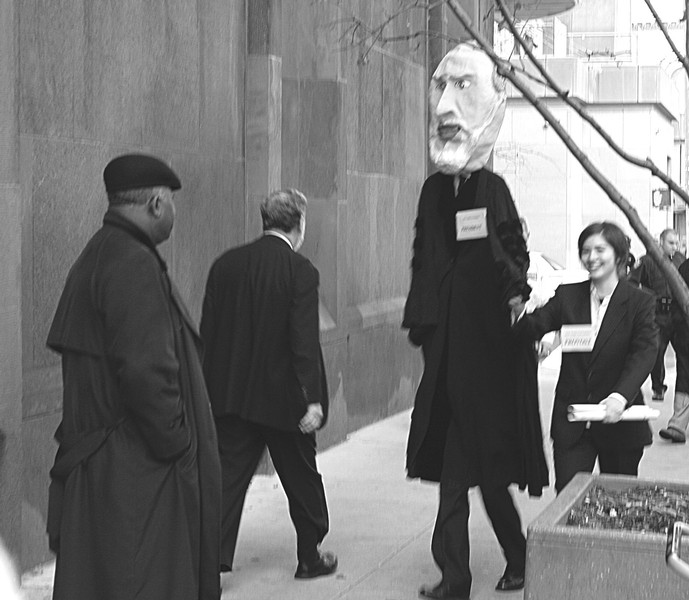
I'm exhausted, and I don't really have a probing, meditative post in me right now, though one certainly begs to be written about the last few days' intensity and everything that's happened, good, bad, mostly good.
We are going to win this strike. We are going to do it because we are strong and committed and because we can. We are going to win this strike because we have to, because too much is at stake to lose, let alone give up.
On February 28 2003, a Friday, the Friday before the March strike, the Reverend W. David Lee told the folks assembled at the First & Summerfield Methodist church a story. He told us about a guy in an art museum who saw a painting of a man playing chess with the devil. The painting was titled "checkmate." The man stared at the painting intently, studying the chess pieces deployed on the checkerboard. His tour group left him behind, i seem to recall, but were loudly reminded of his presence when he began to loudly exclaim "It's a LIE! The Devil has another move!" (Please correct me if i have this all wrong, Josh, Julie, Alek, Katie, or anyone else who was there.) At this point, Reverend Lee brought the message home: "Local 34 has another move! Local 35 has another move! 1199 has another move! GESO HAS ANOTHER MOVE!"
We struck for a week in the freezing cold, 500 undergrads walked out of classes in the middle of a blizzard to watch the snow accumulate atop Cornel West's head and create an new vision of the university immanent in the relationships between strikers, community members, and students. You know the rest.
Last week, President Sexton gave us an ultimatum. He tried to scare us into submission using the most base and violent kinds of fearmongering and intimidation. Today we stood up and said "We're not gonna take it." And "we won't back down." We overwhelmingly resolved to stay out. Tomorrow, we're joining working people from across the country to demand justice from our neoliberal, panoptical employer. Be there.
On monday, We'll be walking the picket line at 8 am.
John Sexton has made his move. He's tried as hard as he can (within the constraints of fantastic faculty and undergrad support) to crush us.
He's failed.
GSOC has another move.
My grandmother could organize your grandmother. Unless your grandmother is dorothy healey. In that case, vice versa.
Nov. 30,2005
Dear Sir:
As a former faculty member and as a grandmother of a graduate assistant, I
have to express to you my disappointment and chagrin over the university's
refusal to negotiate with the Graduate Teaching Assistants.
It seems to me that the great institution of NYU can arrive at
an equitable solution to the problems of serving both your student population
and the young scholars who are contributing their energy and intelligence to
help provide the students with the best possible education, an education that
rewards both the university and the students with honors and distinction.
Sincerely, Judith S--------z (Associate
Professor SENAP--retired 1985)
My grandmother just turned 89 at the end of October. When i spoke to her on the phone this morning, she was talking about calling her former colleagues and asking them to write letters as well or take other actions. My grandmother is awesome.
Monday, November 28, 2005
Sexton Threatens to Fire Strikers, Strip Us of Stipends, TAships for 3 Semesters
Here we go. Comments appended.
So that's it. I want to say one thing: WE ARE WINNING. Sexton is sending this email out because he and the NYU administration are scared. They are scared because the end of the semester is coming and they have no one to grade all the undergrads. They are desperate and they are resorting to desperation tactics, which, however much they may scare the shit out of and infuriate me, are ultimately not going to work because we will not let them work. In the face of these threats, we need to stay strong and we need to recognize how much stregnth we have right now and build from it.
See also: NerdsOnStrike

From: NYU President John Sexton (office.president@nyu.edu)
Subject: A Letter to NYU Graduate Assistants
Dear Graduate Assistants,
Your admission to NYU’s graduate programs represents recognition of your
potential to be part of the next generation of intellectual leaders, as men and
women who will fill the ranks of university faculty throughout the world, as
individuals who will lead lives devoted to advanced inquiry. In providing you
with financial aid and the opportunities and responsibilities of assistantships,
we hope to help prepare you for that life.
We recognize that for some of you there is an unfortunate disparity between
the ideal and the reality. In some instances, assistantships have not been
structured to accomplish what we want: to enhance professional development.
There is always a delicate balance between matching undergraduate curricular
needs with the academic and scholarly interests of those who teach; in the case
of GAs, we have not always achieved that balance. While this is not true in
every department, it is true in some.
Our exchanges with one another have been shaped by this reality and the
mistrust engendered by it. We know we must work to bridge the gulf that has
developed, and to align our realities with our ideals.
The recent announcement within Arts and Science limiting assistantship
responsibilities in languages and literature departments to one stand alone
course per semester is a first step. We know we must take others, but these
academic decisions are best determined by schools and departments. The
University will commit resources in support of these efforts. Moving closer to
this ideal, however, will be difficult without restoring an atmosphere of mutual
respect and good faith within the University community.
We appreciate that for some GAs a collectively bargained contract, driven
by a union, provides a greater sense of security; for them the University’s
August decision to move ahead without the union was wrong. For them and others,
the changes to the student health plan and the errors surrounding Blackboard
created doubts about the University’s good will, when both of these issues could
be understood quite differently in an environment of mutual good faith.
For my part, I will not repeat the challenging history that contributed to
the University’s decision to work directly with our graduate students rather
than through the intermediary of a union. Suffice it to say that we accept that,
as we move forward, the burden is on the University to create an environment of
trust as we aim to achieve the ideal. To this end, we propose the following
pathway: for all current and incoming graduate assistants, the University will
offer written contracts based upon their appointment letters. From our
perspective, these commitments already are binding; nonetheless, we will proceed
to document them in a manner that makes clear to all that these contracts
obligate the University and are legally enforceable. These contracts will detail
the terms described last summer, including:
• $1000/year minimum increases in stipends for the 2005-06 academic year
(already enacted), as well as 2006-07 and 2007-08, plus the publication each
April of the next three year’s stipends;
• continued payment by the University of 100 percent of health care
premiums for the comprehensive student health insurance plan; and
• full tuition remission.
But there is more work to be done, and much of it must be driven by
graduate students themselves. Since the beginning of the fall semester, two
groups of graduate students have set to work on matters of importance to
graduate students generally, and graduate assistants in particular. The Graduate
Student Working Group is crafting a rights-and-responsibilities compact that
will provide a basis for defining the relationship between graduate students and
the University. The Working Group is also formulating a permanent grievance
procedure for graduate students to replace the interim procedures presently in
place. Some members of the NYU community have expressed concern about the
fairness of a grievance procedure that ends with the Provost, a University
official. While we must await the Working Group’s proposals, we are open to any
suggestions they may have regarding how members from the academy outside the
University might play a role in this process.
The Graduate Affairs Committee of the Student Senators Council has also
started to address economic and benefit issues affecting graduate students in
general and GAs in particular. Again, we must see what this group proposes; were
it, however, to offer a new mechanism that would enable graduate assistants
elected at the department level to act as representatives of all GAs in annual
discussions of stipend levels, health care benefits, and other matters of
importance, we would embrace that as part of our university governance
procedures. Lastly, I wish to talk about the strike. Many GAs have continued
teaching, others have taught at off-campus locations, and still others have not
been teaching. I believe that those striking have been acting out of conscience.
Though I fervently disagree with their decision not to teach, I do not think
they made this choice lightly. But however strongly felt a graduate assistant’s
act of conscience may be, it should not be pursued any longer at the expense of
undergraduates.
So far, those who have been on strike have been able to act out of
conscience without experiencing consequences for their actions; instead, the
burdens have fallen on departments, faculty, and, in particular, our
undergraduates. Because graduate assistants are also our students, those on
strike have continued to receive their stipends, they have continued to receive
free tuition, and they have continued to receive free health insurance.
Their points have been made and heard. The time has come for the University
to insist that the academic needs of its undergraduates be met. All of us should
share a deep commitment to meeting these needs. Those undergraduates in classes
affected by the strike are understandably anxious about the disruption to their
studies. Such disruption must not continue. I thank those who have been
teaching, and I ask those who have not to return to the classroom.
For those graduate assistants who resume teaching and other assistantship
assignments by Monday, December 5th (or the first class meeting thereafter) at
the assigned times and places, and who fulfill all assigned responsibilities for
the remainder of the semester, including grading, there will be no consequences.
These GAs will be eligible for teaching and other assignments by the department
for the spring semester. This amnesty represents a balance between our respect
for the principled positions of those choosing to strike and our obligation to
undergraduates, who have a right to complete their semester’s work and
experience no disruption in their courses next semester. Because we take both
responsibilities seriously, graduate assistants who do not resume their duties
by December 5 or the first scheduled teaching assignment thereafter – while
experiencing no consequences for this semester – will for the spring semester
lose their stipend and their eligibility to teach.
For those graduate assistants who return by December 5th and accept a
teaching assignment for the spring, this acceptance comes with the commitment to
meet their responsibilities without interruption throughout the spring semester.
Absences not approved by the dean will result in suspension from assistantship
assignments and loss of stipend for the following two consecutive semesters.
Graduating students will be assessed comparably. None of the striking graduate
students will have their ability to continue their own studies affected. In all
cases, their tuition and health benefits will remain in place, and where the
suspension of stipend would create economic hardship, loans will be provided to
students upon their request.
For those who will be satisfied with nothing less than a union, I know it
will be a disappointment that the University will not recognize GSOC/UAW as the
collective bargaining representatives of NYU’s graduate assistants. I
nonetheless hope that we share a goal to make graduate education at NYU better,
even if we differ about the vehicle for achieving this, and that we can come
together around this goal.
This has been a difficult and rancorous semester. While I do not condone
what has been done by those who have been striking, their actions have caused us
to take a hard and unflinching look at ourselves and our practices, and these
self- examinations will lead to significant, enduring improvements. I hope that
in this spirit we can work together to complete the semester and rebuild the
trust we need.
Sincerely,
John Sexton
So that's it. I want to say one thing: WE ARE WINNING. Sexton is sending this email out because he and the NYU administration are scared. They are scared because the end of the semester is coming and they have no one to grade all the undergrads. They are desperate and they are resorting to desperation tactics, which, however much they may scare the shit out of and infuriate me, are ultimately not going to work because we will not let them work. In the face of these threats, we need to stay strong and we need to recognize how much stregnth we have right now and build from it.
See also: NerdsOnStrike
Sunday, November 27, 2005
revolutionary slash nutcase
When i finish "November Rain," I'm thinking about moving on to "Wild Side" (Hey babe, take a walk on the strike line,) and, even better, reworking the Tribe Called Quest song which sampled it as "Can I Picket." I like Kweli's shout out to Octavia Butler on the (somewhat odd, but endearing) song about Lauryn Hill.
I'm feeling like I'm being totally ineffective as an organizer, if I can even call myself that right now. Whenever anyone hands me a list to phonebank i get seized by this irrational terror of the phone, and the conversations i have are all tentative and badly organized and generally not productive. Maybe i need to keep practicing. Maybe i need to find someonbe to do some roleplays with me - the problem is, we don't necessarily talk to the same people all the time in our organizing, so roleplaying might wind up being imprecise and less helpful than it is for folks who are talking to the same six people every day or every week. It's possibile that i just generally suck at this, but there have been enough moments in my life where i've felt competent enough at this to be of enough use to somebody's organizing to continue to do it. Part of me would like to see us do more face to face stuff rather than phone-based conversations, as a potential means of countering some of the atomizing aspects of the experience of being a graduate student in New York City. But i'm not sure the same shit wouldn't be holding me back if we did that. Plus, sometimes it's hard to grab a cup of coffee with someone when you're on strike. And we'd still have to phonebank anyway. Anyone have any ideas?
I'm feeling like I'm being totally ineffective as an organizer, if I can even call myself that right now. Whenever anyone hands me a list to phonebank i get seized by this irrational terror of the phone, and the conversations i have are all tentative and badly organized and generally not productive. Maybe i need to keep practicing. Maybe i need to find someonbe to do some roleplays with me - the problem is, we don't necessarily talk to the same people all the time in our organizing, so roleplaying might wind up being imprecise and less helpful than it is for folks who are talking to the same six people every day or every week. It's possibile that i just generally suck at this, but there have been enough moments in my life where i've felt competent enough at this to be of enough use to somebody's organizing to continue to do it. Part of me would like to see us do more face to face stuff rather than phone-based conversations, as a potential means of countering some of the atomizing aspects of the experience of being a graduate student in New York City. But i'm not sure the same shit wouldn't be holding me back if we did that. Plus, sometimes it's hard to grab a cup of coffee with someone when you're on strike. And we'd still have to phonebank anyway. Anyone have any ideas?
right about seven years ago
The new Kweli "mix" cd is actually quite good. Probably better than Beautiful Struggle, abandoning the Kanye beats for less flashy stuff from DJ Khalil, Pen Skills, Charlemagne, and Jay Dilla. The result is that the rhymes kind of speak for themself, which is generally a good thing. We actually get a Mos Def verse, and it's a good one - no homophobia, no anti-semitism, just "respiration"-style good mos def, for a change. The track with MF Doom is ok, but i got issues with the "it's like having relations without the penetration" line. I also don't think the production is really worthy of either Kweli or MF. It's not so much that it'sbad as that it's not weird enough. I'm going to shut up now, because i clearly have no fucking idea what i'm talking aboot.
Friday, November 25, 2005
2. We need a vacation
Seeing Goblet of Fire for a second time, with my horde o' cousins, my brother Lev, and my cousin Kyla's friend who does American Studies at Brown, made me all the more aware of some of the more glaring sexualized moments which dominate the film's narrative, of which the scene with Myrtle in the bath is only the most glaring and obvious. My favorite du jour is the scene when, having just been rejected by Cho Chang, Harry is lying on his bed clutching/fondling the big golden egg, which here looks like nothing so much as a big shiny phallus. It's awesome.
Thanksgiving was good. I love my horde o' cousins. My 13 year old cousin has apparently hung out with Yo La Tengo. My 17 year old cousin is applying to colleges. My 5 year old cousin has decided that I am crazy and last night she and my three year old cousin (who likes to sing a song about monkeys -- hmmmmm!!!) attempted to "imprison" me beneath a table. My one year old cousin is really enjoying the whole walking thing and makes lots of funny noises. My soon-to-be ten year old cousin has sort of positioned herself as the baby's second mother, which is really cute. Kyla, who's two years older than me, and her sister Jenny, who's Lev's age, are both really cool, and I don't get to see them enough.
Now that family obligations are for the most part over, (i'd like to see Lev again before he flies back to Chicago,) I have all this other shit I want to get done this weekend prior to sunday night phonebanking, but won't. I need to do laundry. That will probaby happen tomorrow morning. I need to start researching some papers. I need to reread chunks of Immigrant Acts. (It's been a while.) I really need to read Eric Zolov's Refried Elvis, which I've decided to present on next week, since I had to choose a book to read and I've been wanting to read it ever since i saw it on K's bookshelf however many years ago. I need to read the Anne Norton book on Straussianism, which I'm told is very odd. And, of course, i also need to figure out how to do this whole organizer thingt again, and how to do it effectively. Maybe i should just kidnap Alek and make him give me some organizing support. Or i guess i could, like, ask Brenda or something. Right, good plan.
Thanksgiving was good. I love my horde o' cousins. My 13 year old cousin has apparently hung out with Yo La Tengo. My 17 year old cousin is applying to colleges. My 5 year old cousin has decided that I am crazy and last night she and my three year old cousin (who likes to sing a song about monkeys -- hmmmmm!!!) attempted to "imprison" me beneath a table. My one year old cousin is really enjoying the whole walking thing and makes lots of funny noises. My soon-to-be ten year old cousin has sort of positioned herself as the baby's second mother, which is really cute. Kyla, who's two years older than me, and her sister Jenny, who's Lev's age, are both really cool, and I don't get to see them enough.
Now that family obligations are for the most part over, (i'd like to see Lev again before he flies back to Chicago,) I have all this other shit I want to get done this weekend prior to sunday night phonebanking, but won't. I need to do laundry. That will probaby happen tomorrow morning. I need to start researching some papers. I need to reread chunks of Immigrant Acts. (It's been a while.) I really need to read Eric Zolov's Refried Elvis, which I've decided to present on next week, since I had to choose a book to read and I've been wanting to read it ever since i saw it on K's bookshelf however many years ago. I need to read the Anne Norton book on Straussianism, which I'm told is very odd. And, of course, i also need to figure out how to do this whole organizer thingt again, and how to do it effectively. Maybe i should just kidnap Alek and make him give me some organizing support. Or i guess i could, like, ask Brenda or something. Right, good plan.
Thursday, November 24, 2005
Well, that email we were all expecting from the administration yesterday came as expected. (Although for some reason, i never got it. Maybe this means they're gonna kick me out!)
John Beckman, NYU's spokesperson, has been arguing for weeks that there was no "disruption." Now we have the administration scrambling to find ridiculously insufficient solutions which don't address the real problems at all for a disruption which Beckman will no doubt continue to claim doesn't exist. His words are ringing increasingly hollow. This strike is having a huge effect and everyone knows it. And if Beckman doesn't start changing his tune, he's going to start making Vin "What Strike?" Petrini look good by comparison.
John Beckman, NYU's spokesperson, has been arguing for weeks that there was no "disruption." Now we have the administration scrambling to find ridiculously insufficient solutions which don't address the real problems at all for a disruption which Beckman will no doubt continue to claim doesn't exist. His words are ringing increasingly hollow. This strike is having a huge effect and everyone knows it. And if Beckman doesn't start changing his tune, he's going to start making Vin "What Strike?" Petrini look good by comparison.
Tuesday, November 22, 2005
best chant ever
courtesy of Sean
"2,4,6,8:
John Sexton is an asshole.
3,5,7,9:
Where's my fucking contract?"
"2,4,6,8:
John Sexton is an asshole.
3,5,7,9:
Where's my fucking contract?"
next time it's wet and rainy and below 40 fahrenheidt,
and i plan on walking in circles for hours, remind me to wear more layers. And buy a new umbrella. That would help.
stakes is high
I really should post a more in depth entry about yesterday, but for now, this will have to suffice. We had some great picketing at Bobst and Silver (and class discussion on Reconstructing Womanhood was fun, although I think Phil gave us a little too much contextualization (no such thing, i know) and maybe we could have engaged Hazel's arguments a little more. A little odd to talk about Michael Denning like 15 minutes after walking a picket line with him, but such is life. Great to see the GESO(/217) folks who came down yesterday, particularly Kristie, who I hadn't seen in a long time (and the last time I saw her she was in strike mode.) And yeah, it's pretty awesome that they brought Michael, who, if you're jumping on this ship late, i took the equivalent of seven classes with in undergrad and have a huge amount of respect and admiration.
Last night's organizing committee meeting was the best we've had since I've been here. NYU is trying to scare us, to weaken us, but we are getting better at this, we're not just holding on -- in some ways, we're getting stronger. So whatever these mystery announcements are tomorrow, without diminishing the many hardships people are dealing with to stay on strike or the pressure they are facing from administrators and anti-union faculty, I'm very confident that we're going to win this fight and that we can stay out until we do.
Last night's organizing committee meeting was the best we've had since I've been here. NYU is trying to scare us, to weaken us, but we are getting better at this, we're not just holding on -- in some ways, we're getting stronger. So whatever these mystery announcements are tomorrow, without diminishing the many hardships people are dealing with to stay on strike or the pressure they are facing from administrators and anti-union faculty, I'm very confident that we're going to win this fight and that we can stay out until we do.
Sunday, November 20, 2005
Harry Potter and the hilariously uncomfortable adolescent sexuality.
I finally saw Goblet of Fire at the Court Street UA theater last night. On the whole, it's pretty excellent. The love hectangle stuff with Harry and Ron and Cedric and Cho Chang and Hermione and Victor Krum is fantastic. Newell and the cast do the post-pubescent sexual angst and occasional Ron-Harry (and Harry-"Moody", and Harry-Cedric) homoeroticism ("don't get your wand tied in a knot") extraordinarily well. I disagree with Evan on the ending, which didn't feel nearly uncomfortable enough to me, given the tone of the book and the film's allusions to September 11th and the politics and sentiments of catastrophe, although neither of the people with whom I saw the film agreed that these allusions were there (at least in Goblet. They're pretty hard to ignore in Phoenix and Prince.) This film actually scared me. The scenes in the water during the second trial, and in the maze, and at the graveyard were horrific. The guy who plays Neville was terrific.
Saturday, November 19, 2005
Yesterday, a police officer told me that ours was the best picket line he'd ever seen.
I think it was because of Maris and the trumpet, but how awesome is that?
***
Yeah, um, so why is this in the frigging NYT?
I think it was because of Maris and the trumpet, but how awesome is that?
***
Yeah, um, so why is this in the frigging NYT?
Friday, November 18, 2005
freezin for a reason
In which i steal another Yale chant for application to the NYU struggle, and it is met with cautious indifference. people did chant it for a while though.
We started the day off at 8 in the morning with a ridiculous game of "duck duck unionbuster." The last time i played duck duck goose was in high school gym class, after the teacher had pretty much given up on the possibility of getting me or my high school girlfriend or any of our friends to do anything athletic. That was ironic, this was more of a desperate attempt to stay warm. We followed it (and the hokey pokey and red light, green light,) with a wonderfully postmodern picket line which wound to and fro seemingly at random, following no teleology whatsoever, and included random zigs and zags and hopping and jumping and crouching and all kinds of interesting interactions with sidewalk curbs and white traffic lines. The UMass GEO folks came down and brought us these awesome hats which say "UNION SI" on them. I'm wearing mine under my black wool hat, and i look like a total hipster. We chanted, we sang, we stopped having feeling in our feet. Still nowhere near as cold as, say, day one of the March 2003 strike, but this could get pretty brutal. Given the cold, the picket line was pretty fantastic, and folks from Rutgers, CUNY, Columbia, and GESO came down. Among the four Yale political scientists who came down (plus an American studiesist) was JPM, a friend from undergrad whom it was good to see. Maris dropped a new trumpet hook - Tom Petty & The Heartbreakers' "Won't Back Down," but the GSOC chant someone will no doubt quote excessively when they write a book/article about this whole thing is the one which seems to be the unquestioned favorite of just about everybody, the "1. We are the union 2.We need a contract 3. A little bit louder: WE ARE GSOC!" chant, with which my own love affair has yet to end.
This weekend will consist of Hazel Carby's Reconstructing Womanhood (finished chapter 1 yesterday, and it's really good, which is unsurprising) and hopefully Mike Newell's Harry Potter and The Goblet of Fire.
We started the day off at 8 in the morning with a ridiculous game of "duck duck unionbuster." The last time i played duck duck goose was in high school gym class, after the teacher had pretty much given up on the possibility of getting me or my high school girlfriend or any of our friends to do anything athletic. That was ironic, this was more of a desperate attempt to stay warm. We followed it (and the hokey pokey and red light, green light,) with a wonderfully postmodern picket line which wound to and fro seemingly at random, following no teleology whatsoever, and included random zigs and zags and hopping and jumping and crouching and all kinds of interesting interactions with sidewalk curbs and white traffic lines. The UMass GEO folks came down and brought us these awesome hats which say "UNION SI" on them. I'm wearing mine under my black wool hat, and i look like a total hipster. We chanted, we sang, we stopped having feeling in our feet. Still nowhere near as cold as, say, day one of the March 2003 strike, but this could get pretty brutal. Given the cold, the picket line was pretty fantastic, and folks from Rutgers, CUNY, Columbia, and GESO came down. Among the four Yale political scientists who came down (plus an American studiesist) was JPM, a friend from undergrad whom it was good to see. Maris dropped a new trumpet hook - Tom Petty & The Heartbreakers' "Won't Back Down," but the GSOC chant someone will no doubt quote excessively when they write a book/article about this whole thing is the one which seems to be the unquestioned favorite of just about everybody, the "1. We are the union 2.We need a contract 3. A little bit louder: WE ARE GSOC!" chant, with which my own love affair has yet to end.
This weekend will consist of Hazel Carby's Reconstructing Womanhood (finished chapter 1 yesterday, and it's really good, which is unsurprising) and hopefully Mike Newell's Harry Potter and The Goblet of Fire.
Thursday, November 17, 2005
(a strike update)
more on that later.
For folks reading this in exotic locales like Denver or SFO or Pittsburgh or wherever, today was an extraordinarily cold day here. So cold the cops let us plug our coffee machine into a street lamp outlet at the Bobst line. So cold i was shivering through three layers of heavy clothing and my thick wool cap. We're talking March 3, 2003 cold. But folks were still out on the line at 8 AM picketing, shouting, leafletting, and we were there at 5, singing along with the labor chorus folks who came to visit us. Undergrads are sending hundreds of strike-related postcards home to parents. Faculty members stood, shivered, and marched with us, and a guy from GSEU and a bunch of CUNY folks braved the cold wind to walk the line in solidarity with us.
The administration is intensifying its effotrs to buy some of us off and force others back to work through threats and intimidation tactics. Now is not the time to go into details- i'll do that later, when and if the details become matters of public record. So much is at stake here. We can not let them break this union. We cannot let them single us out. We cannot let them force us to return to work without negotiating with our union.
I'm frustrated with academic stuff. The departmental chaos, rumors of faculty departures, failed classes, etc. By forcing this strike, NYU may dash its hopes of ever joining the ranks of the elite institutions to which it aspires and whom it emulates. I'm afraid that NYU's reckless attempts to crush our union are going to have very specific and injurious effects on graduate education - my education. Forcing or driving faculty elsewhere, defunding programs like mine, and either forcibly rejecting or effectively discouraging faculty hires whom i might want to work with are not unrelated. At stake is the attempt by the administration here to consolidate the neoliberal university at all cost. Even if we win the strike, how do we effectively combat this.
Oh. So this evening after picketing i get talked into leafletting some event by one of the union staffers. As we're walking to the subway I ask the local president what the event is, and she tells me that it is the place (a nonprofit legal research center affiliated with NYU) where a friend works. I verbally note this, I'm urged to call said friend and ask if we can possibly get into the benefit at all, i leave a frantic message on her voice mail before we dissappear into the 4 train, but she doesn't get it and we don't connect until we're already leafletting outside. Initially we have a bad relationship with some folks from the center and from the benefit venue. Alec Baldwin walks by, as does Mark Green. It's frigid. Eventually we establish a working relationship with folks from the center when we assure them we're not protesting them, just the NYU trustee who's the honorary chair of the silent auction, and i have some good conversations with some folks from the center, one of whom lives in my neighborhood, and another who previously worked for (Unite-HERE) Local 100. We hand out 200 leaflets, then take off. I wonder how Minnie Driver's doing these days. We go way back.) I leafletted my friend's job. It was totally surreal.
Nerds On Strike have the text of the new letter from the deans to department chairs regarding teaching assistantships, and Specter of Marx offers some trenchant commentary.
I'm feeling a little bummed because i totally forgot about the cohort "happy hour" and came directly home after leafletting. I'll see folks monday i guess, and i'm wiped out and am probably going to do the "wake up at 5:30 and walk to campus" thing tomorrow morning, but i wish i could have put in the time tonight to see folks before thanksgiving break.
On STRIKE. Shut it down. New York is a UNION town.
For folks reading this in exotic locales like Denver or SFO or Pittsburgh or wherever, today was an extraordinarily cold day here. So cold the cops let us plug our coffee machine into a street lamp outlet at the Bobst line. So cold i was shivering through three layers of heavy clothing and my thick wool cap. We're talking March 3, 2003 cold. But folks were still out on the line at 8 AM picketing, shouting, leafletting, and we were there at 5, singing along with the labor chorus folks who came to visit us. Undergrads are sending hundreds of strike-related postcards home to parents. Faculty members stood, shivered, and marched with us, and a guy from GSEU and a bunch of CUNY folks braved the cold wind to walk the line in solidarity with us.
The administration is intensifying its effotrs to buy some of us off and force others back to work through threats and intimidation tactics. Now is not the time to go into details- i'll do that later, when and if the details become matters of public record. So much is at stake here. We can not let them break this union. We cannot let them single us out. We cannot let them force us to return to work without negotiating with our union.
I'm frustrated with academic stuff. The departmental chaos, rumors of faculty departures, failed classes, etc. By forcing this strike, NYU may dash its hopes of ever joining the ranks of the elite institutions to which it aspires and whom it emulates. I'm afraid that NYU's reckless attempts to crush our union are going to have very specific and injurious effects on graduate education - my education. Forcing or driving faculty elsewhere, defunding programs like mine, and either forcibly rejecting or effectively discouraging faculty hires whom i might want to work with are not unrelated. At stake is the attempt by the administration here to consolidate the neoliberal university at all cost. Even if we win the strike, how do we effectively combat this.
Oh. So this evening after picketing i get talked into leafletting some event by one of the union staffers. As we're walking to the subway I ask the local president what the event is, and she tells me that it is the place (a nonprofit legal research center affiliated with NYU) where a friend works. I verbally note this, I'm urged to call said friend and ask if we can possibly get into the benefit at all, i leave a frantic message on her voice mail before we dissappear into the 4 train, but she doesn't get it and we don't connect until we're already leafletting outside. Initially we have a bad relationship with some folks from the center and from the benefit venue. Alec Baldwin walks by, as does Mark Green. It's frigid. Eventually we establish a working relationship with folks from the center when we assure them we're not protesting them, just the NYU trustee who's the honorary chair of the silent auction, and i have some good conversations with some folks from the center, one of whom lives in my neighborhood, and another who previously worked for (Unite-HERE) Local 100. We hand out 200 leaflets, then take off. I wonder how Minnie Driver's doing these days. We go way back.) I leafletted my friend's job. It was totally surreal.
Nerds On Strike have the text of the new letter from the deans to department chairs regarding teaching assistantships, and Specter of Marx offers some trenchant commentary.
I'm feeling a little bummed because i totally forgot about the cohort "happy hour" and came directly home after leafletting. I'll see folks monday i guess, and i'm wiped out and am probably going to do the "wake up at 5:30 and walk to campus" thing tomorrow morning, but i wish i could have put in the time tonight to see folks before thanksgiving break.
On STRIKE. Shut it down. New York is a UNION town.
Subscribe to:
Posts (Atom)