This afternoon John Sexton sent an email to the entire NYU 'community.' It is a curious email. In it, Sexton boasts of having increased the "average scholarship grant from 34% of tuition to 55% of tuition," and details the ongoing efforts to raise $1 billion dollars for undergraduate financial aid. Now, a %21 increase in financial aid would indeed by a good thing, if tuition itself had not increased by more than thirty percent over the same period. For the 2013-14 year, NYU has estimated that tuition and fees, health insurance, and room and board all add up to a cost of over 72,000. As such it's really not that much of a surprise that NYU generates massive levels of student debt - the most of any university with more than 10,000 students, says the Wall Street Journal, Because NYU has so many students, this means it is also the tax-exempt school which generates more aggregate student debt than any other such institution in the U.S. (That doesn't include U of Phoenix or Nova Southeastern, which have gotten rich in part by consuming GI Bill money and spitting out degreeless veterans or veterans with worthless degrees.) In his claim, then, that he is "calling our community together – students, faculty, administrators, alumni, Trustees – and re-sharpening our focus on financial aid and student debt," the JSex doth protest too much.
Indeed both of the two initiatives that the email actually describes - a "Finish Line" grant program to reduce debt by as much as $5,000 and a "Global Pathways Scholarship" program (GPS! GET IT?) to defray costs of studying abroad by as much as $4000 are at best purely cosmetic. NYU student debt is often far higher than its median $30,000, a figure likely deflated by the large number of very wealthy students whose parents bankroll their education, and the difference between $80,000 and $75,000 is pretty small in the scheme of things. At worst they are cynical ploys, PR stunts attempting to rebrand NYU as debt conscious and concerned about students' welfare in contrast to Sexton's earlier strategy of telling overburdened students to consider CUNY - a move some students brilliantly parodied several years ago, and as a defense against the critiques made by groups like NYUFASP and SAASP and, before them, Take Back NYU and the Tuition Reform Action Coalition. The GPS logic is particularly flimsy. NYU makes large amounts of money sending students abroad while charging them New York-equivalent tuition and board, a practice it intends, as Sexton notes in his email, to expand further. The GPS is less a charitable attempt at providing students with an opportunity to defray the costs of lost wages than it is a fairly crude spatial fix.
There are steps NYU could take to alleviate debt burdens. President Sexton could sell the Fire Island bungalow that student debt paid for and donate the money to the financial aid fund. He could throw in the next three years of his $1.5 million salary and whatever obscene amount of money NYU plans to pay him each month after he steps down in 2016. These would be reformist gestures, of course. They would never address the structural questions which have made the contemporary university into a debt vampire, an agent of racial capitalism, grown engorged from the contingent labor of so many adjuncts and temps and subcontracted workers across its global network, flush with oil money and grand plans. But Sexton could take these steps tomorrow. He will not in part because he does not give a shit about students in debt except to the extent that said debt keeps him in bungalows and other sundry real estate holdings, and it makes him look bad. It threatens his self-crafted image as the avuncular cosmopolitan liberal subject of a new global order structured by the globalization of university neoliberalism which privileges NYU's commodification of alterity and geographic urban cartographic non-contiguity. Back before Abu Dhabi, Sexton had a name for this practice, "embracing the other," a term which placed his own well-known predilection for granting and demanding hugs from students at the center of a development-oriented diplomacy, the object of which was, through the embrace of difference, to make NYU the "university of the other" for the 21st century. At the heart of that vision, making it possible, was the labor of south and southeast asian guestworkers building the emirati campus, student debtors working twenty or thirty hours each week trying to stay afloat, de-unionized graduate employees, exploited adjuncts, clerical workers fending off demanded contractual takebacks, school of continuing and professional studies students funneling money down the for-profit drain to help finance John Sexton's air travel between New York and Abu Dhabi to instruct grateful colonials about the wonders of god and baseball.
If there is any value in this latest missive, it is perhaps the evidence that several years of increasing scrutiny of NYU debt and increasing militancy of NYU debtors and their allies have the administration on the defensive. Our move now.
Thursday, October 3, 2013

Wednesday, September 11, 2013
unpaid labor in US universities, II
I got pulled down the rabbit hole of graduate student spousal labor by the combination of my chapter and the intro to the labor history text i mentioned a couple posts ago. But I think it's important to acknowledge that one of the originary and preeminent forms of labor sustaining U.S. universities was that of enslaved people of African descent. Slave labor - in the form of George Berkeley's Rhode Island plantation - funded Yale's first scholarships. The profits of a slave trader endowed the university's first chaired professorship. "Slave labor contributed towards the financial foundation of the Yale Library system," and slave labor's profits flooded the university's coffers during its first endowment drive. University faculty owned slaves and university donors made their fortunes on the trade in slaves and the commodities their labor produced. For many years, in the room where the Yale Corporation meets, a painting was hung depicting Elihu Yale with a shackled slave kneeling at his feet. Until very recently, Calhoun College, one of Yale's dormitories named after slavery advocate John C. Calhoun, featured a stained glass display of enslaved people of African descent at work in a cotton field.
The Browns of Providence, the benefactors of their namesake university, bankrolled slave trading voyages in the same year they made their gift to the university. Other slave traders donated wood hewn by slaves' hands, or the living labor of their slaves themselves for fixed periods. As at Yale, Brown's endowment was built on the labor of enslaved people. More informally at both Brown and Yale, professors' ownership of individual slaves made possible their own teaching and research work and thus also contributed to the universities' prominence and wealth. The history of Harvard, one of the oldest and most important and prestigious of American universities, is not dissimilar. Harvard, writes historian Sven Beckert, "had the labor, products, and profits of slavery woven into its very fabric."
At least in the Yale case, the project of unraveling this fabric was an oppositional one born of struggles over university labor. The report Yale, Slavery, and Abolition, well timed to interrupt Yale's tercentennial autohagiography, was largely the work of three graduate student labor activists with support from local antiracist and peace activists. Management initially sought to minimize, debunk, and dismiss the claims which emerged from the research - a project into which eminent anti-union faculty who had played important roles in persecuting the leaders of the 2005 grade strike were easily recruited. Although the community organizing around the report was coopted by the attacks on the world trade center and the march to war in Afghanistan, the university's ultimate response was death by cooptation - it held a conference on "Yale, New Haven, and American Slavery" over a year after the report's publication, which, according to one participant, completely failed to take up the report's findings or thematic concerns. The institutional response at Brown was far more significant, set in motion in part by the university president, herself responding to earlier calls for reparations. Harvard's own examination was spearheaded by history department faculty who sought to use the university's history as a teachable moment in the relationship between slavery and northern capital.
The labor of slaves made possible the creation of the American university. The traffic in and exploitation of enslaved bodies, of racialized labor as pure commodity, saleable, usable as collateral, required for all of the other labor it made possible, were instrumental to and inextricable from the establishment and reproduction of the colonial and modern American university in both northern institutions and southern ones (like Clemson and Emory, whose president made news last year by citing the three fifths compromise as an ideal example of bipartisan cooperation.) The slave trade and the history of the founders and funders of the earliest and most venerable institutions of U.S. higher education thus continue to haunt the university of the present. The endowment booms of the pre-crisis aughts, the investments in private prisons and water privatization schemes and oil companies complicit in the Sudanese civil war and the farallon capital management llcs and other sundry university (as) hedge funds - all of them were made possible by a recirculation of money prime produced in part by the labor of enslaved people. At the outset of this post I claimed that slave labor was the originary form of the unpaid labor on which universities operate. Maybe that's wrong, both because those other forms coexisted with slave labor, from the very beginning of the U.S. university. And maybe it's wrong because slave labor was never merely unpaid, never defined primarily by the absence of a wage, but instead different in form and character from the modes of unpaid labor I referenced in the previous post. Free labor was not slave labor's opposite but rather a coexistent mode of production built upon its foundation, and the university has long modeled the synthesis of both, reappropriating and recirculating surplus extracted from multiple forms of free and unfree labor and exploitation towards its own growth and that of the classes which manage it. The unpaid surplus labor over which capital exerts its control is not the same as the enslaved labor which was so profoundly important for A materialist account of university labor and its racialized history of integration into and profits from the "fabric" of imperial capital makes salvific, reformist narratives which demand the university's redemption or its return to its original mission prior to neoliberal distortions wholly insufficient. We may be able to move beyond the university, but if we are serious about the decolonial, we can never save it. Nor should we want to.
_014244_956579807.jpg)
The Browns of Providence, the benefactors of their namesake university, bankrolled slave trading voyages in the same year they made their gift to the university. Other slave traders donated wood hewn by slaves' hands, or the living labor of their slaves themselves for fixed periods. As at Yale, Brown's endowment was built on the labor of enslaved people. More informally at both Brown and Yale, professors' ownership of individual slaves made possible their own teaching and research work and thus also contributed to the universities' prominence and wealth. The history of Harvard, one of the oldest and most important and prestigious of American universities, is not dissimilar. Harvard, writes historian Sven Beckert, "had the labor, products, and profits of slavery woven into its very fabric."
At least in the Yale case, the project of unraveling this fabric was an oppositional one born of struggles over university labor. The report Yale, Slavery, and Abolition, well timed to interrupt Yale's tercentennial autohagiography, was largely the work of three graduate student labor activists with support from local antiracist and peace activists. Management initially sought to minimize, debunk, and dismiss the claims which emerged from the research - a project into which eminent anti-union faculty who had played important roles in persecuting the leaders of the 2005 grade strike were easily recruited. Although the community organizing around the report was coopted by the attacks on the world trade center and the march to war in Afghanistan, the university's ultimate response was death by cooptation - it held a conference on "Yale, New Haven, and American Slavery" over a year after the report's publication, which, according to one participant, completely failed to take up the report's findings or thematic concerns. The institutional response at Brown was far more significant, set in motion in part by the university president, herself responding to earlier calls for reparations. Harvard's own examination was spearheaded by history department faculty who sought to use the university's history as a teachable moment in the relationship between slavery and northern capital.
The labor of slaves made possible the creation of the American university. The traffic in and exploitation of enslaved bodies, of racialized labor as pure commodity, saleable, usable as collateral, required for all of the other labor it made possible, were instrumental to and inextricable from the establishment and reproduction of the colonial and modern American university in both northern institutions and southern ones (like Clemson and Emory, whose president made news last year by citing the three fifths compromise as an ideal example of bipartisan cooperation.) The slave trade and the history of the founders and funders of the earliest and most venerable institutions of U.S. higher education thus continue to haunt the university of the present. The endowment booms of the pre-crisis aughts, the investments in private prisons and water privatization schemes and oil companies complicit in the Sudanese civil war and the farallon capital management llcs and other sundry university (as) hedge funds - all of them were made possible by a recirculation of money prime produced in part by the labor of enslaved people. At the outset of this post I claimed that slave labor was the originary form of the unpaid labor on which universities operate. Maybe that's wrong, both because those other forms coexisted with slave labor, from the very beginning of the U.S. university. And maybe it's wrong because slave labor was never merely unpaid, never defined primarily by the absence of a wage, but instead different in form and character from the modes of unpaid labor I referenced in the previous post. Free labor was not slave labor's opposite but rather a coexistent mode of production built upon its foundation, and the university has long modeled the synthesis of both, reappropriating and recirculating surplus extracted from multiple forms of free and unfree labor and exploitation towards its own growth and that of the classes which manage it. The unpaid surplus labor over which capital exerts its control is not the same as the enslaved labor which was so profoundly important for A materialist account of university labor and its racialized history of integration into and profits from the "fabric" of imperial capital makes salvific, reformist narratives which demand the university's redemption or its return to its original mission prior to neoliberal distortions wholly insufficient. We may be able to move beyond the university, but if we are serious about the decolonial, we can never save it. Nor should we want to.
Thursday, September 5, 2013
Graduate students' wives as a gendered labor category
As an addendum to my post from last week, I wanted to write down some thoughts on the figure of the graduate students' wife as a source of labor for the university. Although PhD programs at institutions like Yale, which did not co-educate its undergraduate population until 1969, were often open to women far earlier (1892, in Yale's case) than were those same institutions undergraduate schools, the majority of PhD students for most of the 20th century were men. (It wasn't until the end of the 21st century's first decade that women outnumbered men among both full and part time graduate students, with a far larger margin in the latter category. By 2004-5, women also outnumbered men as recipients of doctoral degrees, a figure which includes PhDs as well as MDs, EDs, DDSes, and LLDs.) Many of these 20th century male graduate students were married, and many of them were married to women who were not themselves graduate students. Given the cost of graduate school and the miniscule salaries of teaching assistantships (Yale TAs, for instance, made three hundred dollars per semester until a series of grade strikes in the spring of 1972 raised wages in some departments) women who were married to graduate students often worked to support their households, and often provided universities with a source of short-term labor in a variety of clerical and related positions. But the contingency of these jobs often meant a high rate of employee turnover, which could be destabilizing and expensive for institutional operations.
In a 1968 Yale Daily News article on the restructuring of the university's library system, the turnover of graduate students' wives was raised as a distinct challenge facing library administrators. The graduate student's wife was a common and important, usually informal, category of university labor, bound to the university by the unwaged world of gendered domestic labor as well as by her own waged work, her relationship to the university and both worlds of labor profoundly determined by her gender (as well as her class and her race - there weren't very many black PhD students at Yale, and their wives would have had a much more difficult time gaining access to the kinds of work white students' wives did. The graduate student's wife was a desirable worker because of her education, her impermanence, and her need to earn enough to support both her and her husband, but also a problematic worker for the same reasons. For other library employees, the graduate student's wife could represent at the very least a bellwether of an encroaching "9 to 5 feeling" (this was over a decade prior to the film of the same name.) As wives' turnover clogged the works, remaining employees voiced a feeling that they were themselves "cogs in the machinery" of the increasingly taylorized operations of university managers. But the wives themselves also played important roles in some radical movements within and beyond the university -- several were involved in the women's liberation movement and in radical and populist and labor organizations. In New Haven, for instance, they were critical to initiatives like the American Independent Movement's Radical Community School. Others joined organizing campaigns which were widespread among university clerical and library workers in the 1960s, 70s, and 80s.
Despite challenges to compulsory heterosexuality and marriage and the increasing numbers of women in graduate school since the 1960s, the graduate student's wife has remained both a discursive category within popular culture and a laboring subject, the concern of social scientists. In the conventional mythology of the figure, the woman who supports the student while he works towards his degree (a relation haunted by the implicit failure of normative masculinity) is then abandoned by him upon or nearing completion of his dependence upon her. It's a relationship structured by exploitation made possible by love, or at least justified by love, sustained by the sanctification of gendered forms of work which are projected beyond the walls of the home as an act of sacrifice. She supports him because she loves him, and he leaves her for a younger woman because he has extracted all the use value from her which he cares to. If both instead stick it out, she gets effusive praise in his acknowledgements which invariably belie the real value of her labor, the extent of his dependence upon it. This is what Scheinkman (1988) calls an "asymmetrical marriage". A staff social worker at the University of Chicago's Student Mental Health Clinic in the 1980s, Scheinkman observes that male graduate students dependent upon female partners were likely to "maintain an overadequate position" toward non-academic wives. Like most white working women who were not performing waged domestic labor (some surely were) graduate students wives performed what feminist sociologist Arlie Russell Hochschild called the second shift, unwaged domestic household labor in addition to the waged work they performed outside of the home. (I should note that this is a schema which scholars like Mary Romero have complicated through attention to the particular forms of value and labor extracted from working class women of color who perform domestic and other forms of care work in multiple waged and wageless contexts.) Part of what is interesting to me as graduate students' wives pop up now and then in my archives are the ways in which these women were often working for the university in the formal sphere of clerical and other forms of waged labor, and in the informal sphere of reproductive labor as unpaid workers often making possible both the subsistence of both the household and the reproduction of the academic labor force. Just as the historiography of the university elides and omits the millions of hours of formally-paid service work which has played a significant role in the growth of endowments and the administrative class alike, so it elides the ways in which formally-unwaged labor has been crucial to its project in a variety of forms for much of its existence. It seems to me that this is a history worth exploring at length.
(I describe waged service labor as formally-paid because as Marx notes in Capital, Volume 1, Chapter 18, the capitalist never pays the laborer the full value of the labor. Surplus value is the remnant, the time the worker loses and the capitalist takes gratis. Thus, capital is "is essentially the command over unpaid labor. All surplus-value, whatever particular form (profit, interest, or rent), it may subsequently crystallize into, is in substance the materialization of unpaid labor. The secret of the self-expansion of capital resolves itself into having the disposal of a definite quantity of other people’s unpaid labor."
In a 1968 Yale Daily News article on the restructuring of the university's library system, the turnover of graduate students' wives was raised as a distinct challenge facing library administrators. The graduate student's wife was a common and important, usually informal, category of university labor, bound to the university by the unwaged world of gendered domestic labor as well as by her own waged work, her relationship to the university and both worlds of labor profoundly determined by her gender (as well as her class and her race - there weren't very many black PhD students at Yale, and their wives would have had a much more difficult time gaining access to the kinds of work white students' wives did. The graduate student's wife was a desirable worker because of her education, her impermanence, and her need to earn enough to support both her and her husband, but also a problematic worker for the same reasons. For other library employees, the graduate student's wife could represent at the very least a bellwether of an encroaching "9 to 5 feeling" (this was over a decade prior to the film of the same name.) As wives' turnover clogged the works, remaining employees voiced a feeling that they were themselves "cogs in the machinery" of the increasingly taylorized operations of university managers. But the wives themselves also played important roles in some radical movements within and beyond the university -- several were involved in the women's liberation movement and in radical and populist and labor organizations. In New Haven, for instance, they were critical to initiatives like the American Independent Movement's Radical Community School. Others joined organizing campaigns which were widespread among university clerical and library workers in the 1960s, 70s, and 80s.
Despite challenges to compulsory heterosexuality and marriage and the increasing numbers of women in graduate school since the 1960s, the graduate student's wife has remained both a discursive category within popular culture and a laboring subject, the concern of social scientists. In the conventional mythology of the figure, the woman who supports the student while he works towards his degree (a relation haunted by the implicit failure of normative masculinity) is then abandoned by him upon or nearing completion of his dependence upon her. It's a relationship structured by exploitation made possible by love, or at least justified by love, sustained by the sanctification of gendered forms of work which are projected beyond the walls of the home as an act of sacrifice. She supports him because she loves him, and he leaves her for a younger woman because he has extracted all the use value from her which he cares to. If both instead stick it out, she gets effusive praise in his acknowledgements which invariably belie the real value of her labor, the extent of his dependence upon it. This is what Scheinkman (1988) calls an "asymmetrical marriage". A staff social worker at the University of Chicago's Student Mental Health Clinic in the 1980s, Scheinkman observes that male graduate students dependent upon female partners were likely to "maintain an overadequate position" toward non-academic wives. Like most white working women who were not performing waged domestic labor (some surely were) graduate students wives performed what feminist sociologist Arlie Russell Hochschild called the second shift, unwaged domestic household labor in addition to the waged work they performed outside of the home. (I should note that this is a schema which scholars like Mary Romero have complicated through attention to the particular forms of value and labor extracted from working class women of color who perform domestic and other forms of care work in multiple waged and wageless contexts.) Part of what is interesting to me as graduate students' wives pop up now and then in my archives are the ways in which these women were often working for the university in the formal sphere of clerical and other forms of waged labor, and in the informal sphere of reproductive labor as unpaid workers often making possible both the subsistence of both the household and the reproduction of the academic labor force. Just as the historiography of the university elides and omits the millions of hours of formally-paid service work which has played a significant role in the growth of endowments and the administrative class alike, so it elides the ways in which formally-unwaged labor has been crucial to its project in a variety of forms for much of its existence. It seems to me that this is a history worth exploring at length.
(I describe waged service labor as formally-paid because as Marx notes in Capital, Volume 1, Chapter 18, the capitalist never pays the laborer the full value of the labor. Surplus value is the remnant, the time the worker loses and the capitalist takes gratis. Thus, capital is "is essentially the command over unpaid labor. All surplus-value, whatever particular form (profit, interest, or rent), it may subsequently crystallize into, is in substance the materialization of unpaid labor. The secret of the self-expansion of capital resolves itself into having the disposal of a definite quantity of other people’s unpaid labor."
Thursday, August 29, 2013
On acknowledgement
Reading a Canadian labor history text from the early 1980s. In the preface, the author thanks three women - presumably secretaries or possibly graduate students (or their wives) for executing "the final typing of the manuscript" with "good skill and good humor." I'm struck by a couple things. It's moderately common for faculty to acknowledge departmental clerical and administrative workers in their books, but there is something about the immediacy and intimacy of having another (a gendered other) do one's typing, in a way which has been since displaced by automation and the concomitant shifts in what kinds of work professors do and what kinds of objects, what kinds of congealed labor, they confront every day. In the case of the contemporary historian, it's often the invisible labor of the workers who built the MacBooks in East China factories which reek of toxins. So I'm thinking about those forms of automation and racialized relocation and translation of particular forms of university labor and also of office work in general. I'm thinking about book acknowledgments more broadly too, as a performative space of debt, a gendered space of recognition (and lack thereof) but also of the making-filial of relationships of exploitation and control. And I'm struck by the hierarchies which are present in the passage I quote from above, by how the historian acknowledges but also evaluates the typists, and praises both their competence and their cheerful affect. Even for prominent labor scholars and radicals, the gendered asymmetries of university labor are performatively acknowledged as debt which can't be repaid, as a backwards IOU note, a public rehearsal of mutuality, exploitation, and the forms of inequality on which the university's production of value depends. More on this later - I'm writing on my phone and I'm at 1%.
Thursday, August 22, 2013
I wrote something for The New Inquiry about birdwatching's politics of representation, occasioned by the publication of Richard Crossley's new Crossley ID Guide: Raptors. It was hard to write, because writing about birds is a pretty new thing for me, and if I keep doing it I think I need to engage both visual culture theory and animal studies a bit more deeply than I have in the past, (though I did read several texts of the latter in preparation for this article.) I'm happy with how it turned out though and I'm excited about where it's published - TNI is a pretty great site that folks should be reading and subscribing to if you are not already doing so.
Tuesday, July 2, 2013
Theses on Alex Rodriguez
I should preface this by noting that I am a Mets fan and hate the New York Yankees with a passion hotter than the flames in which George Steinbrenner is currently burning (the same flames which surely beckon to Rudy Giuliani even now.)
I was struck by the way this Tim Keown piece on ESPN.com, which begins with a gratuitous Brokeback Mountain reference, restages a longstanding pattern in the demonization of New York Yankees third baseman Alex Rodriguez. There are no "out" current MLB players, and part of "A-rod's" pathology revolves around a hyperactive heterosexuality -- Madonna, Kate Hudson, Cameron Diaz, some women sitting next to the dugout in Game 1 of the 2012 American League Championship Series, but representations of Rodriguez's heterosexuality have always veered towards the grammar of failure, farce, somewhere between a comedy of errors and the DSM-IV. Indeed, from derogatory fan chants (Gay-rod most common among them,) to abusive twitter explosions to longstanding media fascination with Rodriguez's sexuality, to the centaur autopornography hanging above the slugger's bed, to the quickly photoshopped purses as but one of the gendered reactions to Rodriguez's infamous "slap" of then-Red Sox pitcher Bronson Arroyo's hand during Game Six of the 2004 ALCS, Alex Rodriguez, despite and to some extent because of his much-discussed heterosexuality, is perhaps the most queered figure in contemporary U.S. professional team sports. Haunting and haunted by baseball masculinity's normative logics, Rodriguez's affect has been read as "weird," as "unsettling," "awkward", improperly affected and affectively abberant from the sport's norm. Markers of Rodriguez's abnormality are not limited, then, to homophobic twitter, the Yankee Stadium bleacher section, or talk radio, but are indeed mainstays of even the more intellectual strands of sport commentary. And Rodriguez has offended not only by how he uses his body, (always, for an athlete, a vexed question,) how he talks about and performs desire in public, but also what he puts into his body, for his role in baseball's protracted experiment with posthumanism dubbed "the steroid era" by those for whom a considerable amount rests on the pretense that it has ended.
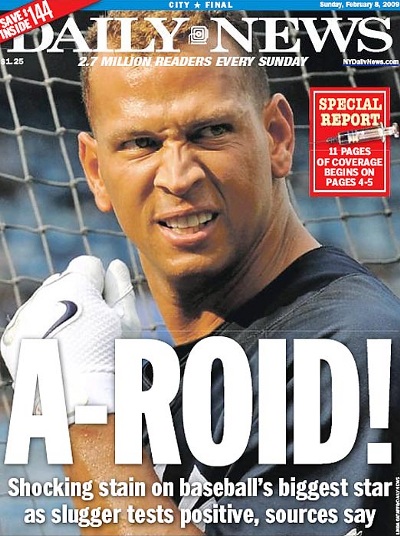
A-roid, the New York tabloids called him, and A-fraud. But the latter had been in use long before Rodriguez's steroid use was known or even suspected. Long before Rodriguez tearfully admitted to using steroids during his years with the Texas Rangers to ESPN's Peter Gammons in 2009 (following a leak of a 2003 positive test,) he was already seen as a fake, as trying too hard, as creepy, "Single White Female-ing" his teammate Derek Jeter and publicly drowning his coaches in unrequited praise. The response to Rodriguez's steroid admission (and the recent reports linking him to Anthony Bosch's biogenesis clinic, along with several other major league stars like Ryan Braun and Nelson Cruz) has proceded by predictably channeling outrage into already-apparent patterns of representing Rodriguez's alterity, feminizing him and producing the steroid syringe as masturbatory phallus. Indeed, since at least the publication of Jose Canseco's book Juiced, with its reports of Texas Rangers players injecting each other in the team's men's room during the 1990s, conversations about steroid use in baseball have acquired a decidedly homophobic tint. Rodriguez has been on the wrong end of the gendered steroid gaze for nearly half a decade now, and if he has largely been spared the more overt racism directed at Barry Bonds, whose career in the major leagues had ended by the time Rodriguez's steroid use became public knowledge, the former shortstop's demonization seemed to proceed in ways which repurposed rather than diverged from the tropes in which his career, mannerisms, and behavior had already been represented and dissected by fans and commentators. The steroid news appeared to prove and legitimate allegations of fraudulence which had dogged Rodriguez for years and which had little to do with his on-field performance.
I was struck by the way this Tim Keown piece on ESPN.com, which begins with a gratuitous Brokeback Mountain reference, restages a longstanding pattern in the demonization of New York Yankees third baseman Alex Rodriguez. There are no "out" current MLB players, and part of "A-rod's" pathology revolves around a hyperactive heterosexuality -- Madonna, Kate Hudson, Cameron Diaz, some women sitting next to the dugout in Game 1 of the 2012 American League Championship Series, but representations of Rodriguez's heterosexuality have always veered towards the grammar of failure, farce, somewhere between a comedy of errors and the DSM-IV. Indeed, from derogatory fan chants (Gay-rod most common among them,) to abusive twitter explosions to longstanding media fascination with Rodriguez's sexuality, to the centaur autopornography hanging above the slugger's bed, to the quickly photoshopped purses as but one of the gendered reactions to Rodriguez's infamous "slap" of then-Red Sox pitcher Bronson Arroyo's hand during Game Six of the 2004 ALCS, Alex Rodriguez, despite and to some extent because of his much-discussed heterosexuality, is perhaps the most queered figure in contemporary U.S. professional team sports. Haunting and haunted by baseball masculinity's normative logics, Rodriguez's affect has been read as "weird," as "unsettling," "awkward", improperly affected and affectively abberant from the sport's norm. Markers of Rodriguez's abnormality are not limited, then, to homophobic twitter, the Yankee Stadium bleacher section, or talk radio, but are indeed mainstays of even the more intellectual strands of sport commentary. And Rodriguez has offended not only by how he uses his body, (always, for an athlete, a vexed question,) how he talks about and performs desire in public, but also what he puts into his body, for his role in baseball's protracted experiment with posthumanism dubbed "the steroid era" by those for whom a considerable amount rests on the pretense that it has ended.


A-roid, the New York tabloids called him, and A-fraud. But the latter had been in use long before Rodriguez's steroid use was known or even suspected. Long before Rodriguez tearfully admitted to using steroids during his years with the Texas Rangers to ESPN's Peter Gammons in 2009 (following a leak of a 2003 positive test,) he was already seen as a fake, as trying too hard, as creepy, "Single White Female-ing" his teammate Derek Jeter and publicly drowning his coaches in unrequited praise. The response to Rodriguez's steroid admission (and the recent reports linking him to Anthony Bosch's biogenesis clinic, along with several other major league stars like Ryan Braun and Nelson Cruz) has proceded by predictably channeling outrage into already-apparent patterns of representing Rodriguez's alterity, feminizing him and producing the steroid syringe as masturbatory phallus. Indeed, since at least the publication of Jose Canseco's book Juiced, with its reports of Texas Rangers players injecting each other in the team's men's room during the 1990s, conversations about steroid use in baseball have acquired a decidedly homophobic tint. Rodriguez has been on the wrong end of the gendered steroid gaze for nearly half a decade now, and if he has largely been spared the more overt racism directed at Barry Bonds, whose career in the major leagues had ended by the time Rodriguez's steroid use became public knowledge, the former shortstop's demonization seemed to proceed in ways which repurposed rather than diverged from the tropes in which his career, mannerisms, and behavior had already been represented and dissected by fans and commentators. The steroid news appeared to prove and legitimate allegations of fraudulence which had dogged Rodriguez for years and which had little to do with his on-field performance.
In at least one other manner, Rodriguez's liminality has been seen as an index of his disloyalty -- his waffling over which team he would play for in the 2009 world baseball classic. Rodriguez was born in New York, but grew up in the Dominican Republic and South Florida. After joining the US team in the 2006 inaugural World Baseball Classic, he planned to switch to the Dominican Republic team for the second iteration of the tournament three years later. He wavered, threatening to sit out the event because of indecision before pledging to return to the US team and then, finally, missing the tournament anyway due to an injury. Venezuelan White Sox manager Ozzie Guillen accused Rodriguez of being a "hypocrite" and "kissing Latino people's asses", but commentary regarding Rodriguez's initial move to play for the DR met with similar criticism from white baseball columnists. It wasn't just the chronically outspoken Guillen sounding off on Rodriguez's betrayal, which seemed itself articulated to notions of the falseness of his latinidad rooted in his dual citizenship, his identity as a US Latino, what others read as his apparent ( and here I am wary of lapsing into psychologizing Rodriguez himself) need to please everyone, to be read both as dutiful American and as proud claimant to the tradition of Dominican baseball. The veracity of this analysis is less important for me (I don't know what Alex Rodriguez thinks about and I don't really care. As already noted I hate the Yankees and everything they stand for.) than is the ways these discourses seem to gel with some of the ways queer Latin@s have written about their own dislocations, diasporic and otherwise, from normative frames of citizenship and cultural nationalism.
I'm not particularly interested in defending Rodriguez. He has lots of money and lawyers for that. And I hate the Yankees and everything they stand for. I am interested in the ways that Rodriguez is implicated in the broader questions around gender, race, masculinity, labor, and the (in)human in sport and popular culture more broadly. So I'll be paying attention to how A-rod's ongoing struggles with Yankee management, Major League Baseball, and Anthony Bosch play out in public view.
Edit: Ok, i guess those weren't really theses. I named this post before I wrote it.
Edit: Ok, i guess those weren't really theses. I named this post before I wrote it.
Subscribe to:
Posts (Atom)