Thursday, August 29, 2013
On acknowledgement
Reading a Canadian labor history text from the early 1980s. In the preface, the author thanks three women - presumably secretaries or possibly graduate students (or their wives) for executing "the final typing of the manuscript" with "good skill and good humor." I'm struck by a couple things. It's moderately common for faculty to acknowledge departmental clerical and administrative workers in their books, but there is something about the immediacy and intimacy of having another (a gendered other) do one's typing, in a way which has been since displaced by automation and the concomitant shifts in what kinds of work professors do and what kinds of objects, what kinds of congealed labor, they confront every day. In the case of the contemporary historian, it's often the invisible labor of the workers who built the MacBooks in East China factories which reek of toxins. So I'm thinking about those forms of automation and racialized relocation and translation of particular forms of university labor and also of office work in general. I'm thinking about book acknowledgments more broadly too, as a performative space of debt, a gendered space of recognition (and lack thereof) but also of the making-filial of relationships of exploitation and control. And I'm struck by the hierarchies which are present in the passage I quote from above, by how the historian acknowledges but also evaluates the typists, and praises both their competence and their cheerful affect. Even for prominent labor scholars and radicals, the gendered asymmetries of university labor are performatively acknowledged as debt which can't be repaid, as a backwards IOU note, a public rehearsal of mutuality, exploitation, and the forms of inequality on which the university's production of value depends. More on this later - I'm writing on my phone and I'm at 1%.

Thursday, August 22, 2013
I wrote something for The New Inquiry about birdwatching's politics of representation, occasioned by the publication of Richard Crossley's new Crossley ID Guide: Raptors. It was hard to write, because writing about birds is a pretty new thing for me, and if I keep doing it I think I need to engage both visual culture theory and animal studies a bit more deeply than I have in the past, (though I did read several texts of the latter in preparation for this article.) I'm happy with how it turned out though and I'm excited about where it's published - TNI is a pretty great site that folks should be reading and subscribing to if you are not already doing so.
Tuesday, July 2, 2013
Theses on Alex Rodriguez
I should preface this by noting that I am a Mets fan and hate the New York Yankees with a passion hotter than the flames in which George Steinbrenner is currently burning (the same flames which surely beckon to Rudy Giuliani even now.)
I was struck by the way this Tim Keown piece on ESPN.com, which begins with a gratuitous Brokeback Mountain reference, restages a longstanding pattern in the demonization of New York Yankees third baseman Alex Rodriguez. There are no "out" current MLB players, and part of "A-rod's" pathology revolves around a hyperactive heterosexuality -- Madonna, Kate Hudson, Cameron Diaz, some women sitting next to the dugout in Game 1 of the 2012 American League Championship Series, but representations of Rodriguez's heterosexuality have always veered towards the grammar of failure, farce, somewhere between a comedy of errors and the DSM-IV. Indeed, from derogatory fan chants (Gay-rod most common among them,) to abusive twitter explosions to longstanding media fascination with Rodriguez's sexuality, to the centaur autopornography hanging above the slugger's bed, to the quickly photoshopped purses as but one of the gendered reactions to Rodriguez's infamous "slap" of then-Red Sox pitcher Bronson Arroyo's hand during Game Six of the 2004 ALCS, Alex Rodriguez, despite and to some extent because of his much-discussed heterosexuality, is perhaps the most queered figure in contemporary U.S. professional team sports. Haunting and haunted by baseball masculinity's normative logics, Rodriguez's affect has been read as "weird," as "unsettling," "awkward", improperly affected and affectively abberant from the sport's norm. Markers of Rodriguez's abnormality are not limited, then, to homophobic twitter, the Yankee Stadium bleacher section, or talk radio, but are indeed mainstays of even the more intellectual strands of sport commentary. And Rodriguez has offended not only by how he uses his body, (always, for an athlete, a vexed question,) how he talks about and performs desire in public, but also what he puts into his body, for his role in baseball's protracted experiment with posthumanism dubbed "the steroid era" by those for whom a considerable amount rests on the pretense that it has ended.
A-roid, the New York tabloids called him, and A-fraud. But the latter had been in use long before Rodriguez's steroid use was known or even suspected. Long before Rodriguez tearfully admitted to using steroids during his years with the Texas Rangers to ESPN's Peter Gammons in 2009 (following a leak of a 2003 positive test,) he was already seen as a fake, as trying too hard, as creepy, "Single White Female-ing" his teammate Derek Jeter and publicly drowning his coaches in unrequited praise. The response to Rodriguez's steroid admission (and the recent reports linking him to Anthony Bosch's biogenesis clinic, along with several other major league stars like Ryan Braun and Nelson Cruz) has proceded by predictably channeling outrage into already-apparent patterns of representing Rodriguez's alterity, feminizing him and producing the steroid syringe as masturbatory phallus. Indeed, since at least the publication of Jose Canseco's book Juiced, with its reports of Texas Rangers players injecting each other in the team's men's room during the 1990s, conversations about steroid use in baseball have acquired a decidedly homophobic tint. Rodriguez has been on the wrong end of the gendered steroid gaze for nearly half a decade now, and if he has largely been spared the more overt racism directed at Barry Bonds, whose career in the major leagues had ended by the time Rodriguez's steroid use became public knowledge, the former shortstop's demonization seemed to proceed in ways which repurposed rather than diverged from the tropes in which his career, mannerisms, and behavior had already been represented and dissected by fans and commentators. The steroid news appeared to prove and legitimate allegations of fraudulence which had dogged Rodriguez for years and which had little to do with his on-field performance.
I was struck by the way this Tim Keown piece on ESPN.com, which begins with a gratuitous Brokeback Mountain reference, restages a longstanding pattern in the demonization of New York Yankees third baseman Alex Rodriguez. There are no "out" current MLB players, and part of "A-rod's" pathology revolves around a hyperactive heterosexuality -- Madonna, Kate Hudson, Cameron Diaz, some women sitting next to the dugout in Game 1 of the 2012 American League Championship Series, but representations of Rodriguez's heterosexuality have always veered towards the grammar of failure, farce, somewhere between a comedy of errors and the DSM-IV. Indeed, from derogatory fan chants (Gay-rod most common among them,) to abusive twitter explosions to longstanding media fascination with Rodriguez's sexuality, to the centaur autopornography hanging above the slugger's bed, to the quickly photoshopped purses as but one of the gendered reactions to Rodriguez's infamous "slap" of then-Red Sox pitcher Bronson Arroyo's hand during Game Six of the 2004 ALCS, Alex Rodriguez, despite and to some extent because of his much-discussed heterosexuality, is perhaps the most queered figure in contemporary U.S. professional team sports. Haunting and haunted by baseball masculinity's normative logics, Rodriguez's affect has been read as "weird," as "unsettling," "awkward", improperly affected and affectively abberant from the sport's norm. Markers of Rodriguez's abnormality are not limited, then, to homophobic twitter, the Yankee Stadium bleacher section, or talk radio, but are indeed mainstays of even the more intellectual strands of sport commentary. And Rodriguez has offended not only by how he uses his body, (always, for an athlete, a vexed question,) how he talks about and performs desire in public, but also what he puts into his body, for his role in baseball's protracted experiment with posthumanism dubbed "the steroid era" by those for whom a considerable amount rests on the pretense that it has ended.


A-roid, the New York tabloids called him, and A-fraud. But the latter had been in use long before Rodriguez's steroid use was known or even suspected. Long before Rodriguez tearfully admitted to using steroids during his years with the Texas Rangers to ESPN's Peter Gammons in 2009 (following a leak of a 2003 positive test,) he was already seen as a fake, as trying too hard, as creepy, "Single White Female-ing" his teammate Derek Jeter and publicly drowning his coaches in unrequited praise. The response to Rodriguez's steroid admission (and the recent reports linking him to Anthony Bosch's biogenesis clinic, along with several other major league stars like Ryan Braun and Nelson Cruz) has proceded by predictably channeling outrage into already-apparent patterns of representing Rodriguez's alterity, feminizing him and producing the steroid syringe as masturbatory phallus. Indeed, since at least the publication of Jose Canseco's book Juiced, with its reports of Texas Rangers players injecting each other in the team's men's room during the 1990s, conversations about steroid use in baseball have acquired a decidedly homophobic tint. Rodriguez has been on the wrong end of the gendered steroid gaze for nearly half a decade now, and if he has largely been spared the more overt racism directed at Barry Bonds, whose career in the major leagues had ended by the time Rodriguez's steroid use became public knowledge, the former shortstop's demonization seemed to proceed in ways which repurposed rather than diverged from the tropes in which his career, mannerisms, and behavior had already been represented and dissected by fans and commentators. The steroid news appeared to prove and legitimate allegations of fraudulence which had dogged Rodriguez for years and which had little to do with his on-field performance.
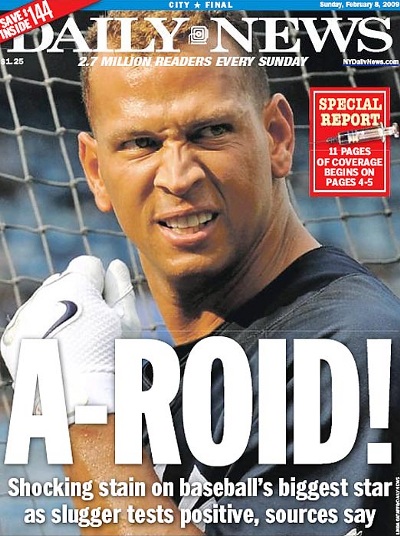
In at least one other manner, Rodriguez's liminality has been seen as an index of his disloyalty -- his waffling over which team he would play for in the 2009 world baseball classic. Rodriguez was born in New York, but grew up in the Dominican Republic and South Florida. After joining the US team in the 2006 inaugural World Baseball Classic, he planned to switch to the Dominican Republic team for the second iteration of the tournament three years later. He wavered, threatening to sit out the event because of indecision before pledging to return to the US team and then, finally, missing the tournament anyway due to an injury. Venezuelan White Sox manager Ozzie Guillen accused Rodriguez of being a "hypocrite" and "kissing Latino people's asses", but commentary regarding Rodriguez's initial move to play for the DR met with similar criticism from white baseball columnists. It wasn't just the chronically outspoken Guillen sounding off on Rodriguez's betrayal, which seemed itself articulated to notions of the falseness of his latinidad rooted in his dual citizenship, his identity as a US Latino, what others read as his apparent ( and here I am wary of lapsing into psychologizing Rodriguez himself) need to please everyone, to be read both as dutiful American and as proud claimant to the tradition of Dominican baseball. The veracity of this analysis is less important for me (I don't know what Alex Rodriguez thinks about and I don't really care. As already noted I hate the Yankees and everything they stand for.) than is the ways these discourses seem to gel with some of the ways queer Latin@s have written about their own dislocations, diasporic and otherwise, from normative frames of citizenship and cultural nationalism.
I'm not particularly interested in defending Rodriguez. He has lots of money and lawyers for that. And I hate the Yankees and everything they stand for. I am interested in the ways that Rodriguez is implicated in the broader questions around gender, race, masculinity, labor, and the (in)human in sport and popular culture more broadly. So I'll be paying attention to how A-rod's ongoing struggles with Yankee management, Major League Baseball, and Anthony Bosch play out in public view.
Edit: Ok, i guess those weren't really theses. I named this post before I wrote it.
Edit: Ok, i guess those weren't really theses. I named this post before I wrote it.
Sunday, April 21, 2013
Friday, April 12, 2013
of institutional instagram accounts and the spectrality of service work
Yale's instagram account (I blog about that place too much, I know) is mostly full of campus building porn and shots of well-dressed undergraduates doing things well-dressed undergraduates do. Sometimes it features old photographs - one of a lone and bedraggled woman undergraduate walking across Old Campus on the first day of Yale's first year as a co-ed institution, one of a Yale swimming team in 1913. These are intended to celebrate the university's history, to situate its past in a teleological narrative of progress, of increasing openness, of constantly embracing modernity and staking a claim on a proprietary futurity which all universities imagine to be their provenance.
Yesterday, though, I noticed this photograph, which someone had reshared on facebook. If the accompanying text notes the time of the photograph (1937), it also clarifies why it has been included in Yale's promotional archive, which seems to exist primarily to sell prospective students on the university's grandeur, and, more salient here, to produce in alumni the sort of uncritically nostalgic affect which might motivate them to donate large sums of their investment banker salaries to the university's development fund. Yale wants us to view this photograph through a fetishized relationship to the geography of the campus. Which residential college is this? Which entryway? The alumni/ae are interpolated into a particular relationship to the university and its ideological and fiscal project through the invitation to recognize themselves and their own experiences of the university through old photographs of familiar spaces.
But labor creeps into the nostalgic gaze in this photograph -- I'm interested in this photograph because it's the only one on their page which depicts a Yale worker - the bearded man mowing the lawn by hand as the golfclub-bearing student passes by, completely indifferent. 1937 was a critical year in the history of the university's labor politics, the year when long-boiling discontent among university maintenance and groundskeeping workers - and administrative repression of students and faculty who advocated for better conditions for the workers - erupted in headlines at the end of the year proclaiming the first attempt by the Committee for Industrial Organization to organize Yale.
"I'd be glad to join any union that comes around here," one worker told the YDN, "and I am sure that I speak for my coworkers when I say this. But the watch us closely, and we are all afraid that if we join we will be put out in the street without a job." Although the News reported skepticism towards the drive among janitors, whom it dismissed as "old traditionalists," within a few years, they would be at the center of the successful organizing campaign, which won its first contract after a short strike on November 9, 1941. We have here, wrote the editors of the Yale Daily News "a real test of Yale's potential liberalism... ...will the university recognize the existence of a problem and face it openly, or will students again be sent to the dean for attempting to find out the bare facts?"
There are, then, histories embedded in this photograph of fetishized plantation architecture and practiced neglect which continue to haunt the university's iconography of power, tradition, and privilege, the specter of immigrant construction labor which built the college in which the scene takes place less than a decade earlier, the specter of hyperexploitation of university labor which was notorious even among students while the photograph was taken, and the specter of all of the struggles which have taken place on the Yale campus in the intervening seven and a half decades. During the March 2003 strike, Mark Wilson, one of the chief stewards of Local 35, the union which was the ultimate result of what began with that 1937 campaign, spoke at a rally supporting workers at Yale-New Haven hospital, about 140 of whom were also on strike. "If they won't let us in the picture," Wilson said, "we'll take the camera and make our own damn picture." I recite this line from memory. It struck me then as an incredibly powerful statement. But the instagram photograph serves a reminder that even when the camera and the photograph are quite clearly in the bosses' hands, histories of labor, struggle, and exploitation remain visible, even if barely, in the stories the university tells us about itself. Pulling on these loose strings of imperial institutional memory, exploding the myths of idyll on which this instagram exercise depends, not to mention the forms of racialized and gendered annihilation which sustain it, strikes me as crucial to creating something other than the university in which we work today.
Edited to add: The best single source on this era in Yale's labor history is Deborah Sue Elkin's unpublished 1995 dissertation Labor and the left at Yale.
Yesterday, though, I noticed this photograph, which someone had reshared on facebook. If the accompanying text notes the time of the photograph (1937), it also clarifies why it has been included in Yale's promotional archive, which seems to exist primarily to sell prospective students on the university's grandeur, and, more salient here, to produce in alumni the sort of uncritically nostalgic affect which might motivate them to donate large sums of their investment banker salaries to the university's development fund. Yale wants us to view this photograph through a fetishized relationship to the geography of the campus. Which residential college is this? Which entryway? The alumni/ae are interpolated into a particular relationship to the university and its ideological and fiscal project through the invitation to recognize themselves and their own experiences of the university through old photographs of familiar spaces.
But labor creeps into the nostalgic gaze in this photograph -- I'm interested in this photograph because it's the only one on their page which depicts a Yale worker - the bearded man mowing the lawn by hand as the golfclub-bearing student passes by, completely indifferent. 1937 was a critical year in the history of the university's labor politics, the year when long-boiling discontent among university maintenance and groundskeeping workers - and administrative repression of students and faculty who advocated for better conditions for the workers - erupted in headlines at the end of the year proclaiming the first attempt by the Committee for Industrial Organization to organize Yale.
"I'd be glad to join any union that comes around here," one worker told the YDN, "and I am sure that I speak for my coworkers when I say this. But the watch us closely, and we are all afraid that if we join we will be put out in the street without a job." Although the News reported skepticism towards the drive among janitors, whom it dismissed as "old traditionalists," within a few years, they would be at the center of the successful organizing campaign, which won its first contract after a short strike on November 9, 1941. We have here, wrote the editors of the Yale Daily News "a real test of Yale's potential liberalism... ...will the university recognize the existence of a problem and face it openly, or will students again be sent to the dean for attempting to find out the bare facts?"
There are, then, histories embedded in this photograph of fetishized plantation architecture and practiced neglect which continue to haunt the university's iconography of power, tradition, and privilege, the specter of immigrant construction labor which built the college in which the scene takes place less than a decade earlier, the specter of hyperexploitation of university labor which was notorious even among students while the photograph was taken, and the specter of all of the struggles which have taken place on the Yale campus in the intervening seven and a half decades. During the March 2003 strike, Mark Wilson, one of the chief stewards of Local 35, the union which was the ultimate result of what began with that 1937 campaign, spoke at a rally supporting workers at Yale-New Haven hospital, about 140 of whom were also on strike. "If they won't let us in the picture," Wilson said, "we'll take the camera and make our own damn picture." I recite this line from memory. It struck me then as an incredibly powerful statement. But the instagram photograph serves a reminder that even when the camera and the photograph are quite clearly in the bosses' hands, histories of labor, struggle, and exploitation remain visible, even if barely, in the stories the university tells us about itself. Pulling on these loose strings of imperial institutional memory, exploding the myths of idyll on which this instagram exercise depends, not to mention the forms of racialized and gendered annihilation which sustain it, strikes me as crucial to creating something other than the university in which we work today.
Edited to add: The best single source on this era in Yale's labor history is Deborah Sue Elkin's unpublished 1995 dissertation Labor and the left at Yale.
Tuesday, April 9, 2013
an excerpt from the chapter I'm working on.
This is an excerpt from the chapter I'm writing about service workers at Yale between 1968 and 1977 and the labor racial politics of university expansion and restructuring. It's raw and will change, but it seemed like something contained and coherent enough that it might work as a blog post. Note that the footnote hypertext doesn't work, since i copy-pasted from Microsoft Word into the Blogger interface...
Even Mayor Lee, the staunch
ally of the Yale Administration, conceded that tax-exemption was a problem for
the city’s continued operation, announcing in February 1969 a five-man
commission to probe the city’s more than $200 million worth of untaxable
property. Part of the problem, Lee explained,
lay in the ways in which the city was subsidizing, through municipal services,
properties which did not serve the city alone, but rather the state and the
nation. This, explained Lee, was “not
equitable.”[1]
But if Lee took pains to ensure that his audience knew he was not simply singling
out the university, it was the Yale/New Haven relationship in particular which
continued to occupy space in the public imagination and in the anxieties of
liberal students, university administrators, and public commenters. In large type, a February, 1969 half-page
advertisement in the In large type, a February, 1969 series of half-page
advertisements in the Yale Daily News promised
“an about face in Yale-New Haven relations” through student voluntarism via the
Yale Charities Drive.[2] The drive’s exclusive focus on New Haven was
a novel development, offered as recognition of “the urgency [with] which our
aid is needed in our own community.”[3] Each advertisement addressed the potential
benefits of the “Yale community’s” involvement in New Haven – education and rehabilitating the poor, involving “inner
city boys in constructive scouting programs.”[4]
The rhetoric of the drive and its leader, Tom McCaughey, both posits New Haven
as the “community” which belongs to Yale, and as the object of the university’s
charity, which might be improved by the intentions and kindness of students,
faculty, administrators, and others to whom the descriptor Yale was easily
available. No facile public relations
exercise, the drive and the language with which it was framed demonstrated a
very real concern among Yale’s students and faculty with the raced and classed
valences of the town-gown dialectic, as well as a desire for easy rapprochement
which cast the city beyond the moats as a mute object. Yale could even “help disadvantaged people
assert their rights and express their feelings in this society.”[5]
But if the charities drive sold itself
on the promise of constructive proximity, the campus’s paper of record’s
report, on the drive’s final day, that two “intruders” and “suspected thieves”
had been apprehended by university police following “a brief struggle” in one
of the residential colleges the previous morning reasserted the equally familiar
relationship of criminalized New Haven youth as a threat to the safety and
property of campus.[6]
That this report itself ran adjacent to
a banner headline announcing proposals for the Social Science Center which
students would denounce scarcely a year later as favoring “administration over
politics, control over education,” underscores the ambivalent, vexed, intimate,
and highly inegalitarian nature of the university’s relationship with the city.[7]
Rituals of inclusion and
exclusion suggested the centrality of the town gown divide in the campus’s
social and spatial imaginary. Perhaps no
incident was more evocative of the contradictory relationship between Yale and
New Haven, between Yale students and black popular culture, between the
liberal, integrationist rhetoric of university administrators and the racialized
logic of its security procedures than that surrounding a campus mixer the
weekend after the charity drive. African
American students in Yale’s Calhoun College, named for the notorious
secessionist and pro-slavery politician John C. Calhoun, had arranged for the
popular soul band Au Naturel, comprised entirely of black Yale undergraduates,
to play a college party. The night ended
when the college’s social committee called the campus police, worried that the “large
number of black New Haveners” outside of the college dining hall waiting to get
in to see the band might start a riot.
The campus police not only shut down the mixer, but also “visited
several private parties and ordered all persons who were not Yale students to
leave.” Some “New Haveners” may have
attempted to enter the college through its windows, “despite the campus police
patrolling outside.”[8] Black students expressed frustration, and one
white member of Calhoun College wrote a guest column in the Yale Daily News expressing his “shock”
and “dismay” at the “subtle racism” of the actions of his colleagues and the
police. The “type of misunderstanding
which apparently led to the mixer shutdown” was “appalling,” because it seemed “rooted
in prejudice and perhaps even paranoia rather than an honest mistake.”
Could it be the blacks were simply having a good time, and only a few whites were so unused to seeing blacks in a crowd that they feared a flight? Blacks cannot be asked nor expected to understand such prejudiced reasoning. The closure of the mixer looks like a raw act of discrimination against a group who finally attempted attending a Calhoun social function despite the fact that they rate Calhoun as one of the most “racist” of the colleges. Perhaps white fear of a fight could have induced one, and this may have warranted closing the mixer. But it is tragic to have to invoke such an explanation for a discriminatory act at so liberal a place as Yale. It indicates a gap of understanding between white and black people which was widened, not narrowed, by Saturday’s action.[9]
[1]
Frank Kryza, “Lee Appeals for Increase in Taxes,” Yale Daily News 2/4/1968
[2]
“An About Face In Yale-New Haven Relations: Education”, advertisement, Yale Daily News 2/10/1969, 3. “An About Face In Yale-New Haven
Relations: Rehabilitation”,
advertisement, Yale Daily News 2/12/1969,
3
[3] “Charity
Drive Begins Today,” Yale Daily News, 2/11/1969
[4] About
Face In Yale-New Haven Relations: Community Involvement”, advertisement, Yale Daily News 2/11/1969, 3
[5]About
Face In Yale-New Haven Relations: Creative Expression”, advertisement, Yale Daily News 2/14/1969, 3
[6] “Berkeley
Struggle: Intruders Stopped,” Yale Daily
News 2/14/1969
[7] Strike
Steering Committee, “Yale A Neutral Institution? Not The Institute of Social Science,” Yale
University Manuscripts and Archives, RU 86 YRG 41 accn 1971-A-004 Box 4 Folder
1. Circa May, 1970
[8] “Crowds,
Outsiders End Calhoun Mixer,” Yale Daily
News 2/17/1969
[9] Craig
A. Salins, “Blacks and Mixers,” Yale
Daily News 2/21/1969
[10]
John F. De Vleming, “Calhoun Mixer Revisited,” letter to the editor, Yale Daily News, 2/25/1969
[11] Tim
Bates, “Black Silence at Yale,” Yale
Daily News 2/28/1969
[12] “BSAY
effort nets 130,” Yale Daily News 3/3/1969
[13]
Robert S. Stein, “Insulate or Integrate,” Yale
Daily News 2/26/1969. Robert A.
Schneider, “Freedom Now,” Demands Yale Money,” Yale Daily News 2/27/1969. Robert
A. Schneider, “Freedom Now: Barnes Denies Commitment,” Yale Daily News 3/3/1969
Sunday, April 7, 2013
I've been neglecting this blog while trying to write a first draft of what will certainly be the longest and most ambitious (god that sounds pretentious) chapter of my dissertation this month. This chapter covers roughly the same workers during the same period (plus six more years) at the same university that I wrote my undergraduate senior thesis about, and it's an interesting challenge both to find new archives and new things to say. I am not really trained as a historian - all of my academic work has been in American Studies departments, and I sometimes feel like I use that as a crutch to not be a better historian than I am, so I am trying to work on that, and I'm trying to find things to say about a moment that strikes me as anticipatory of the present, that seems to echo with later struggles in really interesting ways. But I know that it's lazy and bad history to use that as the only and/or primary way of talking about the moment I am looking at, and part of the challenge of this chapter and the two others I have written about service workers at the same campus is that I have to figure out more compelling ways to theorize these struggles and what they mean than what my first reaction to them was nine years ago when I first started learning about them, which was holy shit, this conjuncture is a lot like the present in really interesting ways. So instead I get to talk about the "blue collar blues," about the proletarianization and organization of teaching assistants in the early 1970s, about the struggles of young service workers of color in the age of DRUM and the League of Revolutionary Black Workers, about budget austerity during the long death of fordist compromise. All of which is pretty fun.
So I have no idea if I am doing a good job, I haven't seen a bird in weeks, I feel profoundly cut off from organizing and radical work, and I have barely left the apartment in months, but I do feel like I have been more productive over the last six months than I have been since I started graduate school, and I suppose that's something, though not something I'm entirely thrilled about in the sense that I have never wanted to be the person who shrugs off organizing responsibilities or radical imperatives to sit in a room alone and write.
Anyway, apropos of nothing, here's a list of stuff I want to read but haven't had time to yet. (In between writing fits I have been working my way through James Geschwender's book about the League, which is really interesting in part for how different it is from Georgakas and Surkin's treatment of more or less the same subject matter.) Hat tips for these go to various people on various commodified social networks, some of whom I know and some of whom I do not.
Ed Emery, No Politics Without Inquiry!
Weaponize the Corpse! Anti-Privatization Struggle at Sussex University
Walter Johnson, River of Dark Dreams
Steve Martinot and Jared Sexton, "The Avant-garde of white supremacy"
Kathi Weeks, "Imagining Non-Work"
and several books piling up on my desk I am really excited about reading someday.
Instead I get to read through scab urbanist books written by scab management professors for the second time and figure out if seven and a half years of graduate school have improved my polemical skills at all.
So I have no idea if I am doing a good job, I haven't seen a bird in weeks, I feel profoundly cut off from organizing and radical work, and I have barely left the apartment in months, but I do feel like I have been more productive over the last six months than I have been since I started graduate school, and I suppose that's something, though not something I'm entirely thrilled about in the sense that I have never wanted to be the person who shrugs off organizing responsibilities or radical imperatives to sit in a room alone and write.
Anyway, apropos of nothing, here's a list of stuff I want to read but haven't had time to yet. (In between writing fits I have been working my way through James Geschwender's book about the League, which is really interesting in part for how different it is from Georgakas and Surkin's treatment of more or less the same subject matter.) Hat tips for these go to various people on various commodified social networks, some of whom I know and some of whom I do not.
Ed Emery, No Politics Without Inquiry!
Weaponize the Corpse! Anti-Privatization Struggle at Sussex University
Walter Johnson, River of Dark Dreams
Steve Martinot and Jared Sexton, "The Avant-garde of white supremacy"
Kathi Weeks, "Imagining Non-Work"
and several books piling up on my desk I am really excited about reading someday.
Instead I get to read through scab urbanist books written by scab management professors for the second time and figure out if seven and a half years of graduate school have improved my polemical skills at all.
Subscribe to:
Posts (Atom)